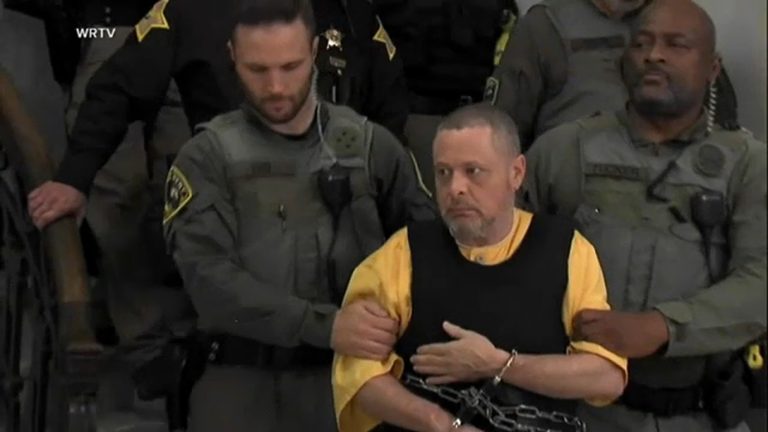
Delphi, Indiana – A man serving a 130‑year prison term for the 2017 murders of two eighth‑grade girls will appear before the Indiana Court of Appeals on Monday to argue for a new trial. Richard Allen, convicted in 2024 of killing Abigail Williams, 13, and Liberty German, 14, says his confession was made while he was undergoing a severe psychological crisis and that the trial improperly barred him from presenting evidence that the killings might have been part of an unknown pagan ritual.
Background of the case
Allen was found guilty after a lengthy investigation that left the small town of Delphi without answers for more than five years. Prosecutors said the evidence against him was overwhelming, even without his confessions. They pointed to Allen’s admission that he was on the trail near where the girls were found, his possession of a handgun, and forensic analysis linking an unspent bullet found between the bodies to his weapon.
The victims’ bodies were discovered down a steep hill near an abandoned railroad trestle. Both girls had been cut at the throat; one was found nude while the other was wearing the first victim’s clothing. No sexual assault was evident, but the positioning of the bodies, scattered branches, and knife wounds formed the basis of the defense’s proposed ritual‑theory.
Defense arguments
Allen’s attorneys contend that he was subjected to extreme solitary confinement and harsh treatment while awaiting trial, leading to a “steep psychological decline.” They cite a brief in which they describe Allen losing weight, being tased, and suffering injuries from unsanitary conditions. The brief argues that these conditions caused Allen to convince himself he was the killer and to make multiple false confessions.
The defense also seeks to introduce an expert who would testify that the crime scene bears hallmarks of a pagan ritual, citing the arrangement of the bodies, the presence of branches, and the outdoor setting as possible indicators of a sacrifice to Odin, a figure from Norse mythology. Prosecutors argue the expert’s examples are limited and that such speculation would turn the trial into a “sideshow.”
Prosecutorial response
State Attorney General Todd Rokita’s office maintains that the evidence against Allen is solid. The brief notes that Allen’s statements coincided with his exposure to discovery materials, including photographs of the victims’ bodies, which forced him to confront “the horrifying evidence of what he did.” Prosecutors also point out inconsistencies in witness descriptions of the suspicious man seen near the trail and argue that the defense’s proposed expert lacks a factual foundation.
Additional issues the appeals court will consider include discrepancies in witness sketches that did not resemble Allen and the denial of a defense request to examine whether marks on an unfired bullet could be traced to a specific gun.
Implications
The hearing will focus on whether Allen’s constitutional right to present a full defense was violated by excluding the ritual‑theory expert and whether his mental state at the time of confession warrants a new trial. While the case does not involve new legislation or policy, it underscores the importance of due‑process protections in criminal proceedings, especially when mental health concerns are present.
Delphi residents, many of whom have followed the case closely through true‑crime media, await the court’s decision, hoping for clarity on a tragedy that still haunts the community.
Original reporting: Allentown News – 6abc Philadelphia — read the source article.