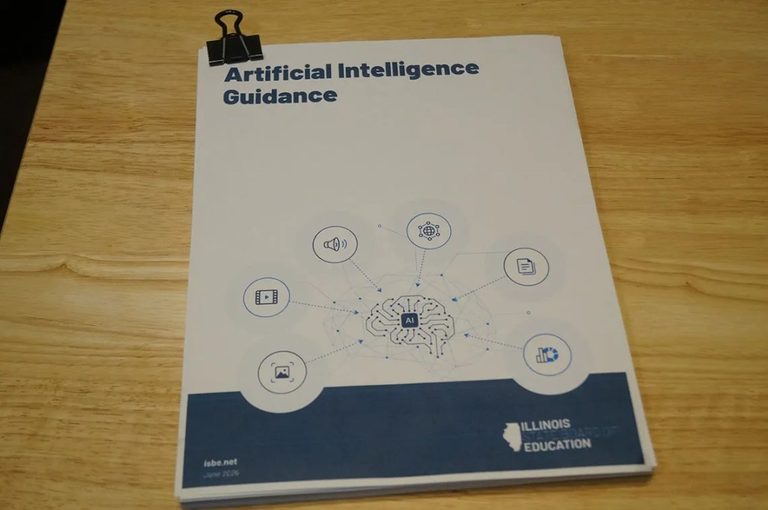
The Illinois State Board of Education has released new guidelines on the use of artificial intelligence in K-12 education. The guidelines were developed with input from a blue-ribbon panel of experts in education, technology, and public policy, and were written with the help of popular AI programs including ChatGPT, Claude, and Gemini.
Guidance Details
The 409-page document provides guidance on the responsible and ethical use of artificial intelligence in schools, including how to select AI applications, how to use AI to inform teaching and learning practices, and how to prevent students from using AI to cheat. The guidance also emphasizes the importance of human relationships and experiences in teaching and learning, and notes that artificial intelligence is only a tool to inform teaching and learning, not a substitute for human interaction.
Bill Curtin, Illinois policy director for the nonprofit advocacy group Teach Plus, praised the guidance, saying that it provides a framework for teachers to develop the skills and ethics needed to use AI effectively in the classroom. Curtin also noted that the use of AI in developing the guidance itself was a positive example of how AI can be used in academic fields.
Background
The guidance was issued in response to legislation passed in 2025 requiring the Illinois State Board of Education to develop guidelines on the use of AI in education. The legislation was prompted by concerns about students using AI programs to cheat, as well as the potential benefits of using AI to improve teaching and learning.
A 2024 survey of Illinois educators found that many teachers and administrators were concerned about the misuse of AI in schools, and were looking for guidance on how to use AI effectively. The survey also found that many educators were unaware of the potential benefits and risks of using AI in the classroom.
Original reporting: Block Club Chicago — read the source article.