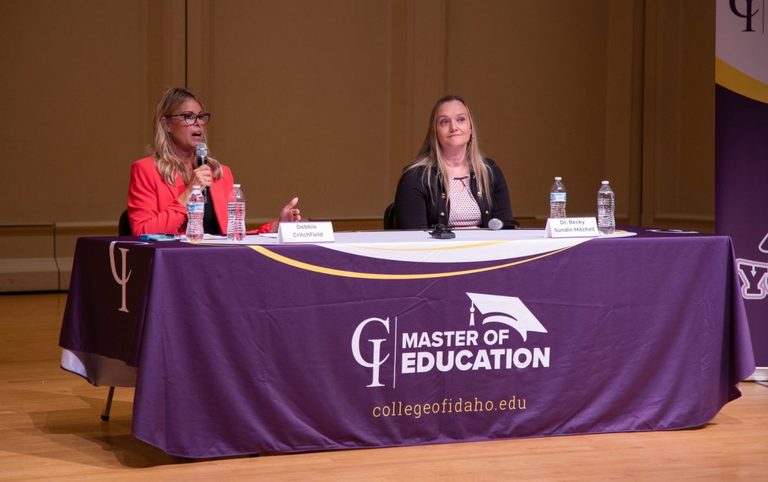
At the College of Idaho’s Langroise Center on Tuesday, Idaho’s two candidates for state superintendent of public instruction presented sharply different visions for funding the state’s K‑12 system. Republican incumbent Debbie Critchfield emphasized her work rewriting the 30‑year‑old funding formula and securing a high‑needs special‑education investment, while Democrat Becky Sundin Mitchell called for enrollment‑based funding and opposed the state’s new private‑school tax credit.
Funding formula rewrite
Critchfield, seeking a second term, said her top priority is to finish a rewrite of Idaho’s school‑funding formula in the 2027 legislative session. She highlighted relationships with legislators that helped pass a fund for high‑needs students last session and promised those same connections will move the formula forward. “I’m looking at something that is predictable and stable,” she told the audience, arguing that a formula based solely on enrollment would hurt many rural districts.
Enrollment‑based funding vs. formula stability
Mitchell, a former teacher of the year who has taught primarily in charter schools, advocated a return to enrollment‑based funding that many districts used during the COVID‑19 pandemic. She argued that Idaho’s public schools, which rank 51st nationally for per‑pupil spending, need more money overall. “Until we can fully fund public schools, we should never be sending money to private schools,” she said, criticizing the $50 million Parental Choice Tax Credit program that subsidizes K‑12 private‑school tuition.
Private‑school tax credit controversy
The tax credit, created by lawmakers last year, has drawn sharp criticism from Mitchell, who called the concept unconstitutional and raised concerns about accountability. She noted that the Idaho Tax Commission has not released data on who received the credits or how the funds were spent, saying, “We don’t know that students are being educated. We don’t know that any schooling is taking place at all.” Critchfield stayed mostly silent on the credit during the debate but expressed dissatisfaction with the lack of transparency, adding, “This is not a yes or no question to me. I think that anytime there is a tax bill that comes forward it needs to earn my support on its merits.”
Special‑education funding
Special‑education funding also featured prominently. Critchfield pointed to a $5 million investment in a high‑needs fund secured in 2026, though she said the 2027 proposal would be reduced to $1.7 million to prioritize the formula rewrite. She described the fund as a temporary measure to “alleviate” the strain on districts until a new formula is in place. Mitchell, whose own child receives special‑education services, called the system “severely under‑resourced” and argued that more overall funding for public schools is the solution.
Role of politics in education
Mitchell asserted that the superintendent’s office should be nonpartisan, stating, “Politics has zero role in education.” She urged legislators to spend more time in public schools to see the challenges firsthand. Critchfield acknowledged that the Legislature often debates social issues, but said her strategy is to secure a seat at the table so she can influence outcomes. “Legislators are comfortable picking up the phone and calling me,” she said, noting that this can help move bills forward or shape final language.
Looking ahead
The debate, organized by Idaho Education News and the College of Idaho, gave voters a clear view of each candidate’s priorities as the November 3 election approaches. The superintendent’s office oversees a $3.2 billion budget, 127 Department of Education employees and roughly 310,000 public‑education students. A livestream of the debate is available on EdNews’ Facebook page, and a recording will be posted on YouTube.
Original reporting: Idaho Education News — read the source article.