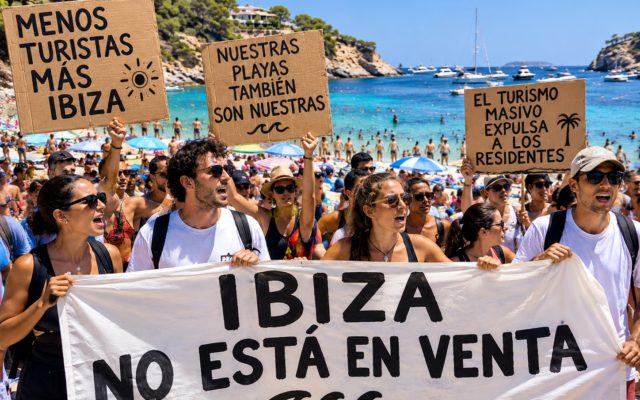
San Antonio – While the world watches the latest headlines from the United States, a quieter but equally important story unfolded on the Mediterranean island of Ibiza. About 100 local residents, many of them young families, converged on Cala Saladeta beach last week to voice a growing frustration with overtourism that is reshaping their daily lives.
Local families fight back against crowded beaches
The protest was organized by the Ibiza Youth Association, a group of island natives who say the surge of visitors each summer has turned public spaces into tourist‑only zones. Demonstrators carried signs that read, “Wherever you look, it’s all tourists,” and shouted that the island “is not for sale.” Their message was clear: public beaches must remain accessible to the people who call Ibiza home.
Beyond the sand – housing, infrastructure, culture at risk
Protesters argued that the problem extends far beyond crowded shorelines. Mass tourism, they claim, has driven up housing costs, strained water and waste systems, and eroded the island’s traditional culture. Young families find it increasingly difficult to afford a home, while long‑time residents worry that the unique character of their communities is being lost to endless development.
“We love our island, but we can’t live here if we have to compete with tourists for a place to sit on the beach or a roof over our heads,” said María López, a 28‑year‑old member of the youth association. “Our children deserve to grow up in a place that feels like home, not a holiday resort.”
Calls for a new tourism model
The group is demanding a shift toward a tourism model that prioritizes residents. They propose caps on daily visitor numbers, stricter zoning for new hotels, and greater investment in infrastructure that benefits locals first. The association has also scheduled a second demonstration for September 20 to oppose a planned expansion of Ibiza’s airport, arguing that additional capacity would only amplify the pressure on the island’s limited resources.
Regional ripple effect
Ibiza’s protest is part of a broader wave of anti‑tourism demonstrations across Spain. Similar rallies have erupted on neighboring Mallorca and in Barcelona, where residents also complain about overcrowding, unaffordable housing, and the environmental toll of millions of annual visitors.
Official response
Ibiza Island Council President Vicent Marí defended the island’s current approach, noting that Ibiza has been a pioneer in managing tourist flows and balancing the needs of visitors with those of residents. He highlighted recent measures such as limiting new hotel licenses and promoting off‑season tourism.
Nevertheless, protesters remain skeptical, insisting that more decisive action is needed to protect the island’s heritage and ensure that locals retain a genuine stake in their community.
Why this matters to families and faith‑based communities
For many families, the fight is about preserving a way of life rooted in close‑knit neighborhoods, local churches, and traditions passed down through generations. The protest underscores a broader concern that unchecked commercial development can undermine the social fabric that faith‑centered communities rely on.
As the debate continues, Ibiza’s residents hope their voices will be heard not only by local officials but also by the millions of tourists who cherish the island’s natural beauty. Their goal is simple: to keep Ibiza a place where both visitors and locals can enjoy the island’s splendor without sacrificing the rights of families to live, work, and worship in peace.
Original reporting: KTSA News/Talk (San Antonio) — read the source article.