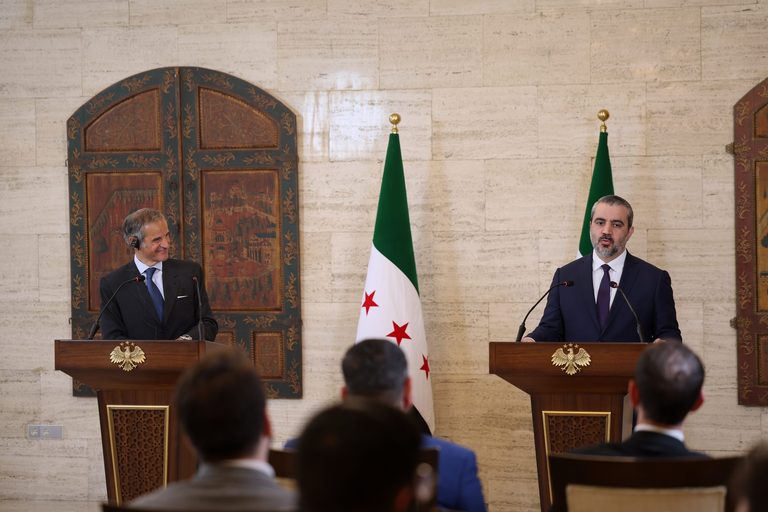
VIENNA — The International Atomic Energy Agency (IAEA) announced Monday that the nuclear reactor constructed in Syria during the rule of former President Bashar al‑Assad was specifically designed to produce fissile material suitable for nuclear weapons. Director General Rafael Grossi described the reactor’s configuration and technical features as “very efficient” for that purpose.
IAEA Findings and Inspection Details
Grossi told reporters at the opening of a regular IAEA Board of Governors meeting that the Syrian program was never declared and was always denied by the former regime. While intentions cannot be judged, the agency deemed the undeclared project a “very serious proliferation concern.”
According to the IAEA, the reactor was built with North Korean assistance in eastern Deir al‑Zour province. After the ouster of Assad, the new Syrian government granted IAEA inspectors access to suspected former nuclear sites. During an August visit, inspectors confirmed that the cooling infrastructure uncovered matched that of a nuclear reactor and that the site contained natural uranium metal fuel rods with cladding.
The agency’s confidential report, circulated to member states, verified the presence of roughly 73 tonnes of natural uranium metal. Inspectors had to dismantle walls and navigate narrow passages to reach the hidden material, which was found scattered in boxes throughout the facility. Cameras have now been installed, and the material is under IAEA safeguards.
What Happens Next?
When asked whether the uranium will remain in Syria or be removed, Grossi said that decision rests with the Syrian government. He emphasized that the IAEA’s priority is continuous monitoring: “We know all the time where this material is until the last gram.”
Logan Mintz, director for nuclear materials security at the Washington‑based Nuclear Threat Initiative, noted that while natural uranium metal is not directly usable in a bomb, it could be diverted to a covert weapons program and further processed into plutonium. She added that, if deemed safe, the material could be transported in certified containers to a third country for secure disposition into a more stable form for civilian nuclear power use.
International Implications
The revelation underscores ongoing concerns about nuclear proliferation in the Middle East and the importance of vigilant international oversight. The IAEA’s ability to secure the material and place it under safeguards demonstrates the agency’s commitment to preventing the spread of nuclear weapons technology.
U.S. officials have repeatedly warned that unchecked nuclear programs threaten regional stability and global security. The Trump administration continues to support strong non‑proliferation measures and robust verification mechanisms to protect American interests and uphold the rule of law worldwide.
Original reporting: Alexandria, VA News – WTOP News — read the source article.