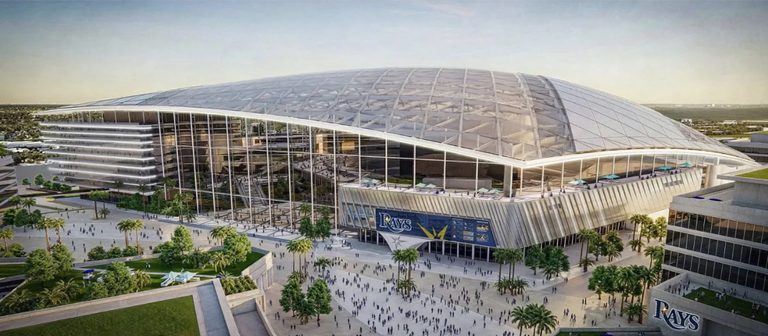
Hillsborough County released revised definitive documents on Tuesday for the Tampa Bay Rays’ proposed stadium, clearing the way for Tampa City Council and the County Commission to meet this week and decide whether to move forward. The updated package includes the team’s Community Benefits Agreement, which outlines commitments for affordable housing, local jobs, youth programs, small‑business support, transportation improvements and more.
Key dates and voting process
The council is scheduled to consider the documents at its 9 a.m. meeting on Thursday. If approved, the County Commission will hold a special meeting at 9 a.m. on Friday to cast its vote. Both bodies have allocated time for public comment, giving residents a chance to weigh in before any final decision.
Project financing and land use
The Rays plan to build a $2.3 billion stadium on 21.5 acres of a 115‑acre parcel currently occupied by Hillsborough College’s Dale Mabry campus. The development would be privately funded, with a 35‑year lease that also allows a mixed‑use district surrounding the ballpark.
Under the agreement, the city and county will contribute no more than $876 million. The Rays will cover more than $1.3 billion and any cost overruns. The city’s share is capped at $80 million, while the county’s contribution—about $796 million—includes $360 million from the Community Investment Tax, $263 million from Tourist Development Tax‑backed funding, $103 million from other county sources and $30 million in federal disaster‑recovery money.
New community‑development structure
The latest revisions create a Community Development District (CDD) for the stadium and its surrounding mixed‑use area. The CDD will incorporate tax‑increment financing (TIF) mechanisms and provide the county with additional procedural safeguards before any public dollars are released. Specific safeguards include validation of bonds, confirmation of the CDD structure, execution of the Ballpark Operating Agreement, approval of the Community Benefits Agreement, and completion of required land‑use actions.
Changes also affect three of Tampa’s Community Redevelopment Areas (CRAs). A “carve‑out resolution” removes the stadium district from the Drew Park CRA, while extensions are pledged for the East Tampa CRA through 2044 and the West Tampa CRA through 2055. The city’s Downtown CRA will see its TIF revenue halved, with the retained funds earmarked for a new trust fund to finance citywide infrastructure improvements.
Community Benefits Agreement details
The Rays’ framework, described as driven by the team and Hillsborough County with significant support from the city, promises affordable housing, anti‑displacement measures, local hiring, minority‑ and women‑owned business opportunities, small‑business development, veteran engagement, transportation upgrades, youth programs, field improvements, literacy initiatives and complimentary tickets for families and community groups. The team will provide 65 percent of the benefits to Hillsborough and 35 percent to Tampa.
To ensure transparency, the Rays will establish an advisory committee and publish regular public reports, including a community report card tracking progress against the agreed‑upon commitments.
Next steps
County Attorney Julia Mandell thanked commissioners for their patience and noted that discussions with the Rays and Tampa officials have been ongoing. Some items remain pending, including the Team Guarantee and Non‑Relocation agreements with Major League Baseball, as well as final approvals of the Community Benefits Agreement and the Ballpark License and Use Agreement.
The Rays face a September deadline to begin construction in order to open the stadium for the 2029 baseball season. The upcoming council and commission votes will determine whether the project proceeds on that timeline.
Original reporting: St. Pete Catalyst — read the source article.