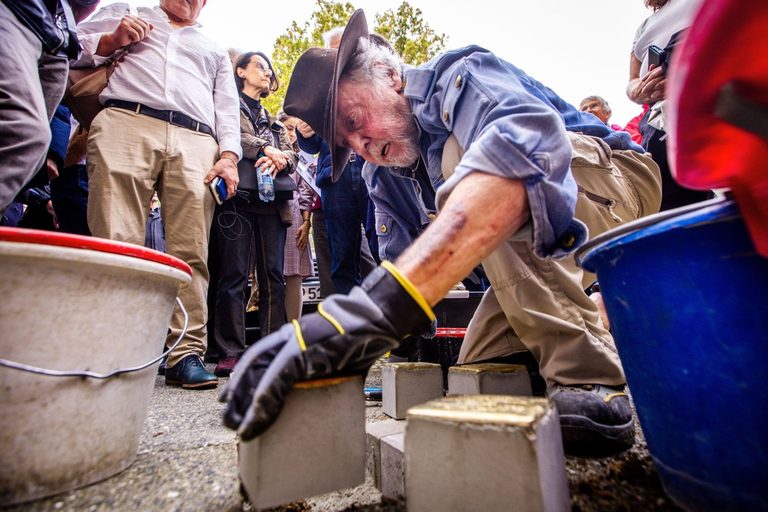
Heidenau, a small town near Dresden in Saxony, voted on Thursday to prohibit the placement of new Holocaust memorial plaques known as Stolpersteine (“stumbling blocks”). The motion was introduced by local branches of the far‑right Alternative for Germany (AfD) and the centre‑right Christian Democratic Union (CDU). Council members argued that pedestrians are “walking over or even stepping onto the names of the victims,” and that future commemorations should be confined to the town’s northern cemetery memorial site.
Local officials’ rationale
Proponents of the ban said the plaques, which are small 10 cm brass cubes set into sidewalks outside former homes or workplaces, disrupt the flow of foot traffic and could be treated disrespectfully. They suggested that a centralized cemetery memorial would better preserve the dignity of the victims while still providing a place for remembrance.
Opposition and broader concerns
The decision has drawn sharp criticism from several quarters. Felix Banaszak, co‑leader of Germany’s Green Party, called the reasoning “absurd” and described the ban as a scandal. He emphasized that the plaques bring the names and fates of victims into everyday life, prompting a moment of reflection for passersby.
Charlotte Knobloch, president of a Jewish association in Bavaria and a Holocaust survivor, also condemned the move, calling it “the completely wrong path.” While she has expressed personal reservations about the Stolpersteine concept, she stressed that decentralized commemoration that remains in public spaces is essential for Germany’s culture of remembrance.
Artist’s response
Gunter Demnig, the German artist who created the Stolpersteine project in the 1990s, rejected Heidenau’s motion. He told German media that the plaques must stay visible at the specific locations where victims lived or worked, arguing that they help bring history to life for younger generations. Demnig noted that the ban was not surprising given the AfD’s recent electoral gains and suggested that the CDU had “perhaps dropped its ‘C’” by moving away from its Christian roots.
Political context
The AfD has long challenged Germany’s forms of Holocaust remembrance. In neighboring Saxony‑Anhalt, the party recently secured a historic win in state elections and has advocated for a revision of school history curricula toward a “more Bismarck – less Hitler” approach. At the federal level, the AfD is designated as a far‑right extremist organization by German domestic intelligence, though that classification is under review.
The Heidenau vote also highlights pressure on Germany’s informal “firewall” policy, which seeks to keep the far right out of mainstream political decision‑making. The CDU’s willingness to cooperate with the AfD on this motion has drawn criticism within the party and comes as Chancellor Friedrich Merz faces a crisis over disappointing regional election results.
International reaction
The International Auschwitz Committee condemned the CDU’s support of the ban, calling it a “transparent and despicable attempt to drive Nazi victims in Heidenau out of the city once again” and to relocate their memory to a cemetery.
To date, more than 116,000 Stolpersteine have been installed across 31 countries, the vast majority in Germany. The plaques carry the victim’s name, date of deportation and place of death, serving as a daily reminder of Nazi atrocities.
Heidenau’s decision underscores an ongoing debate in Germany over how best to balance respect for victims with public space usage, and it raises questions about the future of decentralized memorials in the country.
Original reporting: KTVZ (Central Oregon) — read the source article.