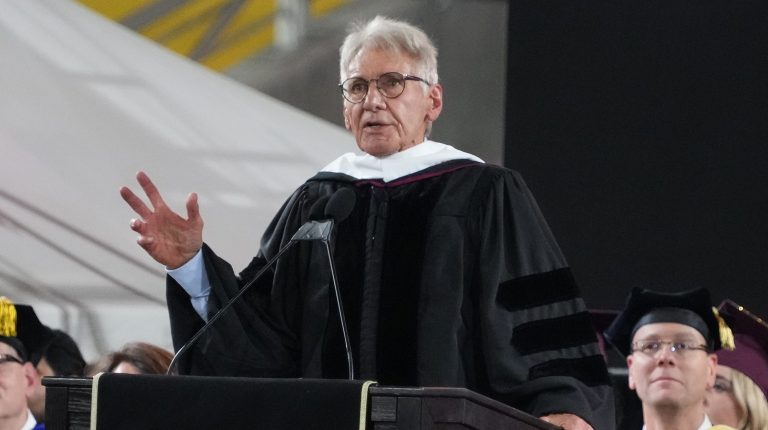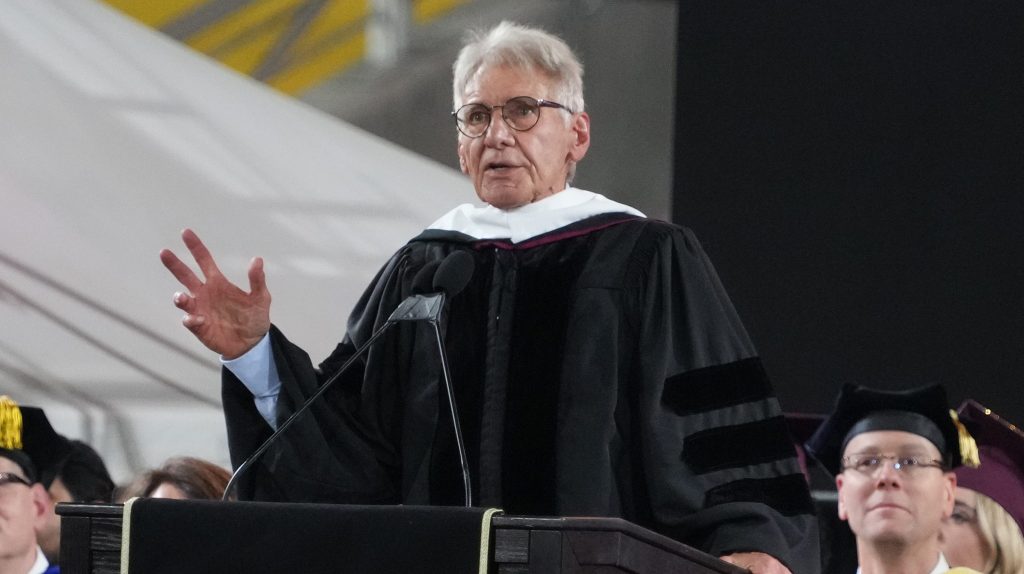
Harrison Ford spoke to Arizona State University graduates in Tempe on May 11, mixing personal origin stories with blunt environmental urgency and a straight-up call to action. He traced a messy path from Ripon College drama class to carpentry jobs to blockbuster success, explained how Conservation International gave him purpose beyond fame, and urged the class to use their influence to fix what his generation left behind. The remarks, part memoir and part pep talk, landed on themes of passion, purpose, and responsibility to the planet.
Ford opened by tipping his hat to the graduates’ commitment, saying they had earned their moment through steady work and choices that mattered. “You made wise choices, followed through with the work. I celebrate your commitment, the combined success of all of you. The potential of your entire generation, that is what gives me hope for the future,” he said, laying out the stakes and the reason he felt optimistic. It was a short, sharp reminder that achievement is a mix of effort and timing.
He went back to his college days at Ripon College, admitting he didn’t always make the best choices and that his early plan didn’t include a clear future. He confessed he’d taken a drama class hoping for an easy A, only to find something unexpected. “My classmates were people I had previously discounted as geeks and misfits,” he said. “But I soon realized, I was a geek and a misfit. I had found my fit. These were my people.”
Finding that fit changed how he saw himself: the stage became a place to experiment with other lives and discover parts of himself. “I began to find myself on stage pretending to be someone else,” he added, and that experimentation planted seeds for a long, slow climb. For years, he balanced acting gigs with carpentry, keeping food on the table while he waited for roles that mattered.
Ford was candid about the lean stretch that preceded fame, refusing to glamorize the grind. “Acting was not yet paying the bills. I was supporting my growing family with carpentry jobs, another way to put food on the table. I loved making things,” he said, painting a picture of a working actor who also built the life around his art. He remembered choosing only parts that pushed him: “And I only took acting jobs when the part challenged me,” he continued. “This went on for about 15 years, during which I did a lot of carpentry and only four or five acting jobs, but they were more ambitious, good projects, and then it all added up, and I got ‘Star Wars.’”
Even after success arrived, Ford argued, something deeper was missing—purpose beyond the paycheck. “The load lightened. I had freedom, opportunity, but something was still missing. Passion and purpose are not the same thing,” he said, drawing a clean line between joy and meaning. “Passion brings you joy. Purpose brings you meaning. Passion gets you out of bed in the morning, but purpose allows you to sleep at night, and I hadn’t found purpose higher than my job.”
That higher purpose came through environmental work, particularly his work with Conservation International, which reshaped what he thought fame could do. He described their core message in plain terms: “Their message was simple: Nature doesn’t need people. People need nature to survive,” he said, and noted that this perspective finally gave him the kind of purpose he’d been chasing. He challenged the graduates to care for the planet because the situation they inherit is serious and immediate: “because the world you’re stepping into, the world my generation left you, is a real mess.”
Ford closed by reminding the class that influence is real, whether they feel it yet or not, and that action creates pressure leaders must answer. “Your generation has far more power than you may realize, and if you harness that power, if you find your leadership, your issues, your voice, the world will not be able to ignore you. You will have to be accommodated. Believe me, I know that’s true,” he said, pointing to the practical power of collective will. He wrapped with a go-for-it charge: “Don’t wait. When opportunity presents, recognize it. This is your time. Own it. Enjoy every second of it, because what could be worse than getting to the end of your life and realizing that you haven’t fully lived it. Congratulations. Go change the world.”