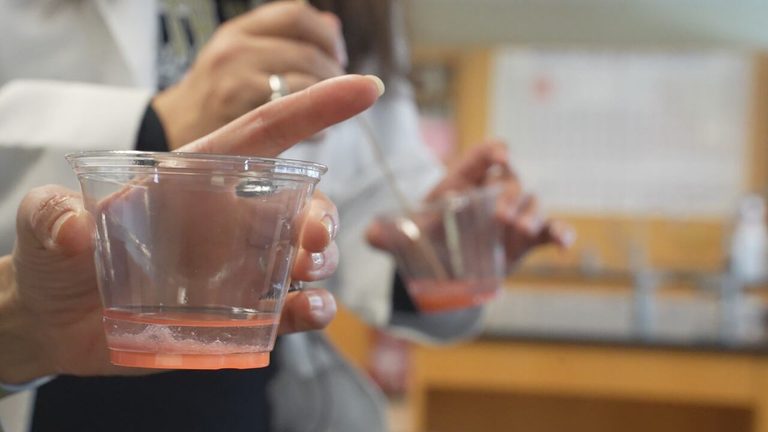
Rapid City, S.D. – This week, South Dakota Mines opened its labs to local families for a quick, hands‑on science experiment. Dr. Elizabeth Racz‑Brunner guided participants through a step‑by‑step DNA extraction using fresh strawberries, dish soap, salt and a bit of mechanical crushing.
Simple steps, big results
The process mirrors the techniques professional scientists use to isolate DNA from cells. First, volunteers mashed strawberries to break open the fruit’s cells – a mechanical lysis step that physically disrupts the cell walls. Next, a mixture of table salt and dish soap was added, creating a chemical lysis solution that dissolves the membranes surrounding the cell nuclei.
After a brief stir, the mixture was filtered and then chilled, allowing the DNA strands to clump together and become visible as a cloudy, stringy precipitate. Because DNA molecules are so large, the resulting strands can be seen with the naked eye, no microscope required.
Encouraging curiosity at home
Dr. Racz‑Brunner encouraged families to repeat the experiment with other fruits such as blueberries or bananas, noting that different fruit textures can affect the amount of DNA recovered. She suggested turning the activity into a friendly competition: “See who can extract the most DNA from a single strawberry,” she said, “and discuss why the results might differ.”
The demonstration highlighted the accessibility of scientific inquiry. All the required materials are inexpensive and commonly found in a kitchen, making it easy for parents, grandparents, or teachers to replicate the experiment at home or in a classroom setting.
Why DNA extraction matters
Understanding DNA is foundational to modern biology, medicine and agriculture. By pulling DNA out of everyday fruit, participants gain a tangible sense of the molecule that carries genetic information for every living organism. The activity also reinforces basic concepts of cell structure, the role of the nucleus, and how scientists isolate genetic material for research.
Dr. Racz‑Brunner emphasized that early exposure to hands‑on science helps children develop critical thinking skills and a lifelong love of learning. “When kids see that they can perform a real scientific procedure in their own kitchen, it demystifies the lab and inspires curiosity,” she explained.
Community response
Local parents praised the event for its educational value and family‑friendly format. “My kids loved actually seeing DNA,” said one participant, “and now they’re asking about genetics at the dinner table.” The demonstration also aligns with South Dakota’s broader push to promote STEM education in schools and community programs.
For families interested in trying the experiment themselves, Dr. Racz‑Brunner provided a simple recipe: 2 cups of fresh strawberries, 1 teaspoon of salt, 1 tablespoon of dish soap, a coffee filter, and a chilled alcohol solution for precipitation. Detailed instructions are available on the South Dakota Mines website.
Looking ahead
South Dakota Mines plans to host additional science outreach events throughout the semester, focusing on topics such as simple circuit building, water quality testing and basic robotics. These programs aim to bring university resources directly to the community, reinforcing the partnership between higher education and local families.
By turning a laboratory technique into a backyard activity, the DNA extraction demo demonstrated that scientific discovery is not confined to research labs—it can happen in any kitchen, fostering curiosity and learning for the next generation of innovators.
Original reporting: KOTA (Gray) – local — read the source article.