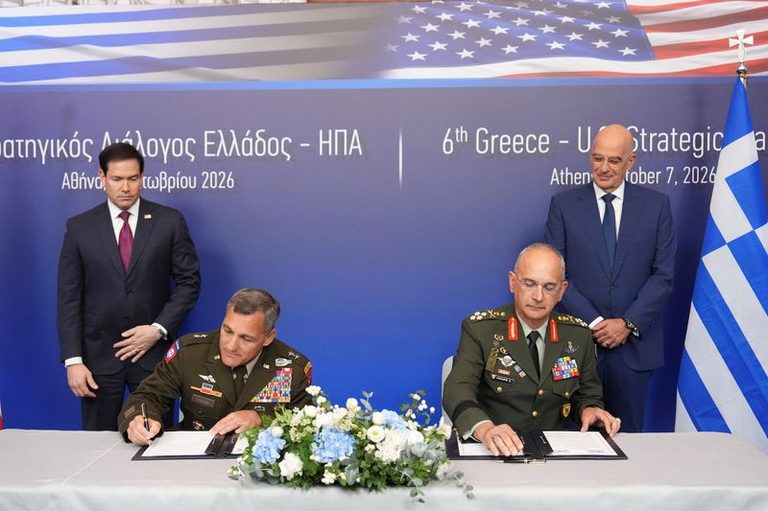
Greece announced a major defense procurement that will see the country spend up to $4 billion on upgrades to its existing F‑16 fleet and the purchase of advanced U.S. weaponry. The deal, confirmed by senior officials in the Greek Defence Ministry and the Foreign Ministry, underscores the deepening security partnership between Athens and Washington.
Key components of the agreement
The package includes new advanced missiles and bombs for the F‑16 “Viper” aircraft, as well as for the newer F‑35 fighter jets and Sikorsky UH‑60M Black Hawk helicopters. In addition, Greece will upgrade roughly 82 older F‑16s to the Viper standard and plans to modernise another 37 Block‑50 aircraft at an estimated cost of about $1 billion.
These procurements are integrated into Greece’s multi‑year defence plan, which already earmarks roughly €28 billion through 2036 for the purchase of U.S.‑made F‑35 fighters, helicopters and the development of the “Achilles Shield” – a layered anti‑ballistic and anti‑aircraft system that will incorporate Israeli‑made weapons.
Financial impact and timeline
Both the defence and foreign ministries stressed that the new spending will be spread over several years, meaning it will not place additional pressure on Greece’s public finances. The country, still recovering from the 2009‑2018 debt crisis and its associated austerity measures, continues to allocate a robust 3.5% of gross domestic product to defence – a higher share than many NATO allies, largely due to ongoing tensions with Turkey.
U.S. diplomatic backdrop
The announcement came a day after U.S. Secretary of State Marco Rubio visited Athens, where he and Greek officials affirmed a joint security plan for counter‑terrorism information sharing between law‑enforcement agencies. Rubio’s remarks highlighted the shared commitment of the two NATO members to regional stability and to bolstering each other’s defence capabilities.
Greece’s earlier 2024 commitments included the purchase of 20 Lockheed Martin F‑35 fighter jets and 35 Sikorsky UH‑60M Black Hawk helicopters. The current upgrade programme builds on that foundation, ensuring the Greek Air Force remains interoperable with U.S. forces and capable of meeting modern threats.
Strategic significance
By modernising its legacy fleet while expanding its fifth‑generation aircraft inventory, Greece is positioning itself as a stronger deterrent in the Eastern Mediterranean. The enhanced capabilities will improve air‑to‑air and air‑to‑ground precision, bolster NATO’s collective defence posture, and support the broader goal of maintaining freedom of navigation in a region marked by geopolitical friction.
U.S. defence manufacturers stand to benefit from the contract, reinforcing American jobs and technological leadership in the aerospace sector. The agreement also signals confidence in the durability of the transatlantic alliance, a cornerstone of U.S. foreign policy under the current administration.
Local perspective
For Greek citizens, the deal promises not only heightened security but also potential economic spill‑overs. Defense contracts often generate local employment in maintenance, training and logistics, offering a modest boost to communities that host military facilities.
Overall, the agreement reflects a pragmatic approach: modernising Greece’s armed forces while managing fiscal responsibility, and deepening a partnership that serves both nations’ strategic interests.
Original reporting: Appleton, WI News Feed (HLL/CB) — read the source article.