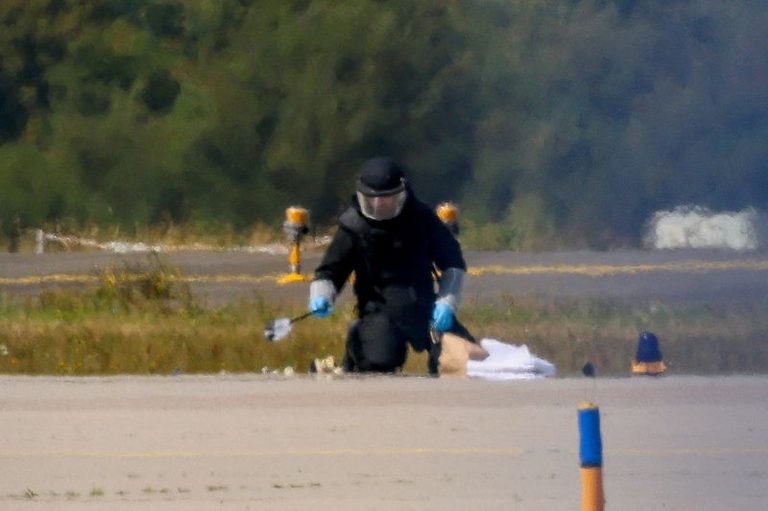
Berlin – In response to a recent failed drone strike on a German airport, the federal government unveiled a sweeping security package aimed at defending the nation’s critical infrastructure from unmanned‑aircraft attacks, cyber intrusions and other forms of Russian sabotage.
New counter‑drone units for cities and government districts
Interior Minister Alexander Dobrindt told Bild am Sonntag that Russia’s hybrid warfare has become a daily reality for Europe. “These attacks will increase, but we can defend and protect ourselves,” he said. Under the new plan, police mobile drone‑defence capabilities will be expanded, with rapidly deployable counter‑drone units stationed in major cities to guard the airspace above transport hubs, government districts and other high‑value locations.
Private operators granted authority to neutralise threats
Companies that run critical infrastructure—such as power utilities and defence manufacturers—will receive legal authority not only to detect hostile drones but also to actively fend them off. This marks a shift from a purely observational stance to a more proactive defence posture, allowing private operators to protect the services that keep daily life running.
National “cyberdome” to thwart hacking attempts
The package also includes the creation of a national protective shield, dubbed a “cyberdome.” This network of digital sensors will monitor for hacking attempts and automatically intercept malicious traffic before it can reach critical systems. The cyberdome is intended to act as a digital perimeter, complementing the physical drone‑defence measures.
AI, facial‑recognition and video surveillance upgrades
To further bolster security, the government plans to expand the use of artificial‑intelligence‑supported technologies, biometric facial‑recognition and video surveillance at key public venues, including railway stations. These tools are designed to identify suspected saboteurs preparing attacks, providing law‑enforcement with early warning capabilities.
Russia has denied involvement in the airport incident and dismissed the allegations as “anti‑Russian action.” Nevertheless, German officials see the episode as a clear signal that hybrid attacks are evolving and must be met with robust, coordinated defences.
The interior ministry did not immediately respond to a request for comment on the details of the proposal.
Original reporting: Appleton, WI News Feed (HLL/CB) — read the source article.