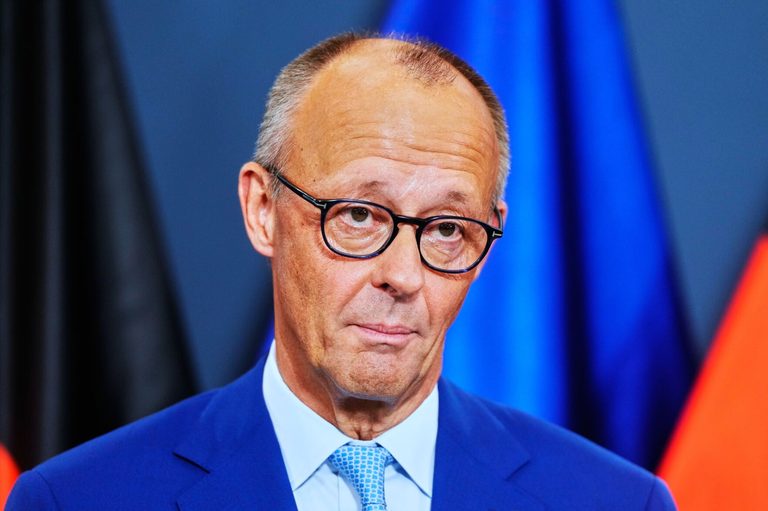
BERLIN — In the wake of two crushing state‑level defeats on Sunday, German Chancellor Friedrich Merz announced he will continue his reform agenda despite the CDU’s historic setback.
Election results spark alarm
Public broadcaster ARD’s exit‑poll projections showed the centre‑right Christian Democratic Union (CDU) receiving only about 5% of the vote in Mecklenburg‑Western Pomerania, the lowest share the party has ever recorded in any German state since World War II. In Berlin, the CDU was projected to finish second with roughly 19.1% of the vote, behind the Left party’s 25.3%.
The far‑right Alternative for Germany (AfD) made significant gains, capturing 37.9% in Mecklenburg‑Western Pomerania and 16.2% in Berlin, though it fell short of forming a regional government.
Merz’s response
Labeling the result a “disaster,” Merz said the outcome underscores the urgency of his government’s reform program. “What needs to be done now requires backbone, steadfastness, and patience,” he declared in a televised statement. “I will demonstrate these qualities as chairman of the CDU and, above all, as chancellor of our country.”
Merz framed the reforms as an “antidote to the poison of authoritarianism,” arguing that strong, market‑friendly policies are essential to protect German society from growing authoritarian sentiment.
Key reforms on the table
The administration’s plan includes:
- Cutting income tax rates for low‑ and middle‑income families.
- Overhauling the pension system to address long‑term sustainability.
- Reducing bureaucratic red tape that businesses and citizens say hampers growth.
These measures aim to stimulate economic activity, improve family finances and restore confidence after years of stagnant growth.
Political fallout
The CDU’s defeat follows a recent loss to the AfD in Saxony‑Anhalt, where the far‑right party posted its strongest showing to date, raising concerns about a potential regional government led by extremist forces.
Within the CDU, some members have called for leadership changes, though no senior officials have publicly demanded Merz’s resignation. Philipp Amthor, a prominent CDU figure who coordinates federal‑state relations, said it was “good and right for these personnel discussions not to be continued now,” signaling an effort to quell internal dissent.
Outlook
Despite the setbacks, Merz remains determined to press ahead, arguing that postponing reforms would only deepen Germany’s economic and social challenges. The coming weeks will test whether his reform agenda can regain public support and counter the AfD’s rising influence.
Original reporting: KTBS 3 (Shreveport) — read the source article.