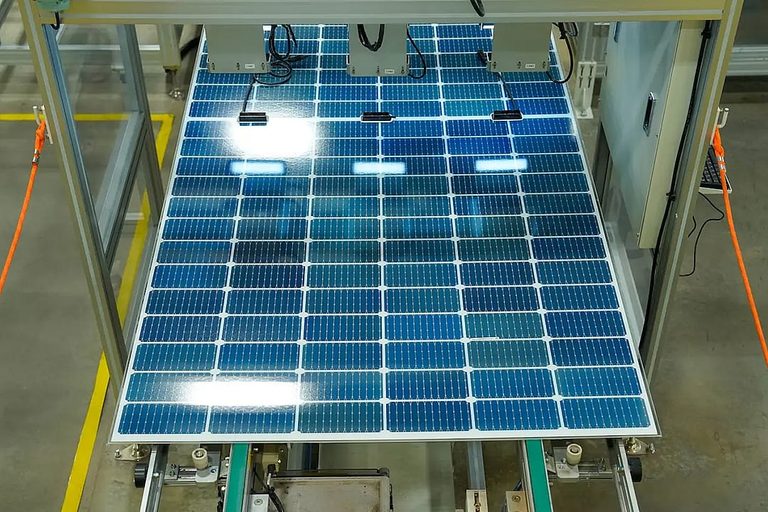
Inside Qcells’ sprawling factory just outside Atlanta, workers and robots handle ultra‑thin slices of polysilicon that become the basic cells of solar panels. The $2.5 billion facility, which consumes 3.5 million gallons of water and 90 megawatts of power, represents a major step toward a full‑line U.S. solar supply chain.
Local expansion amid federal policy shift
In June, the Cartersville plant began expanding from component assembly to complete panel production under one roof. The move reflects a broader push by the Trump administration to revive domestic solar manufacturing after years of Chinese dominance.
President Trump’s latest executive actions, set to take effect in December, will levy new tariffs on imported polysilicon and establish minimum import prices. By raising the cost of foreign material, the measures give U.S. producers like Qcells a competitive edge.
Policy contrast with the previous administration
Under the 2022 Inflation Reduction Act, the Biden administration offered tax‑credit bonuses for projects that used U.S.–made panels, a carrot that helped attract Qcells to Cartersville. By contrast, the Trump administration has taken a stick approach: the “One Big Beautiful Bill Act” eliminated most solar tax credits and barred equipment from certain countries, including China, from the few remaining credits.
Solar‑industry analyst Ben Damiani, chief technology officer at Atlanta‑based Cherry Street Energy, said the policy volatility has been “the biggest hindrance” for manufacturers. Yet he added that having the full supply chain onshore is “critical” for long‑term stability.
Economic impact and outlook
Researcher Coco Zhang of ING notes that while the back‑and‑forth of federal policy creates short‑term uncertainty, the new tariffs could help U.S. firms compete as Chinese imports become more expensive. Qcells has already invested billions in its Georgia facility, a commitment that may pay off if the tariff regime holds.
However, Zhang cautions that smaller companies with less capital may struggle if policy swings continue. The Trump administration’s recent closure of a loophole that allowed China‑based firms to set up shop in the United States further tightens the market.
Broader market effects
Nationally, the phase‑out of clean‑energy tax credits has removed a major incentive for new solar projects. The administration has also moved to cancel federal funding for clean‑energy initiatives and added hurdles for solar and wind installations on federal lands. Some of these actions have been blocked or reversed by the courts, but developers still face higher costs and longer timelines.
According to the clean‑energy advocacy group E2, the first quarter of this year saw nearly $13 billion in abandoned solar, wind, and battery investments, while $18 billion in new projects were announced as developers raced to meet expiring tax‑credit deadlines. The new polysilicon tariffs could help domestic manufacturers meet the demand from these projects, though higher material costs may be passed on to consumers.
Solar’s enduring role
Despite policy turbulence, industry experts agree that solar remains a cornerstone of America’s energy future. The Solar Energy Industries Association reports that solar and storage accounted for 90 percent of new power added to the grid in the first quarter.
“We absolutely should make solar,” Damiani said. “It is the fastest‑deployed, lowest‑cost source of electricity and will be a major part of our energy mix for the next hundred years.”
For Cartersville and the broader Georgia region, the Qcells plant promises jobs, skilled‑trade opportunities, and a step toward energy independence—goals that align with the Trump administration’s focus on national security, labor standards, and American prosperity.
Original reporting: KTVZ (Central Oregon) — read the source article.