Paris – On Tuesday, French civil servants joined a wave of high‑school student protests, shutting down school entrances in several cities to voice opposition to the government’s planned €54 billion savings drive in the forthcoming 2027 budget draft.
Student actions across the country
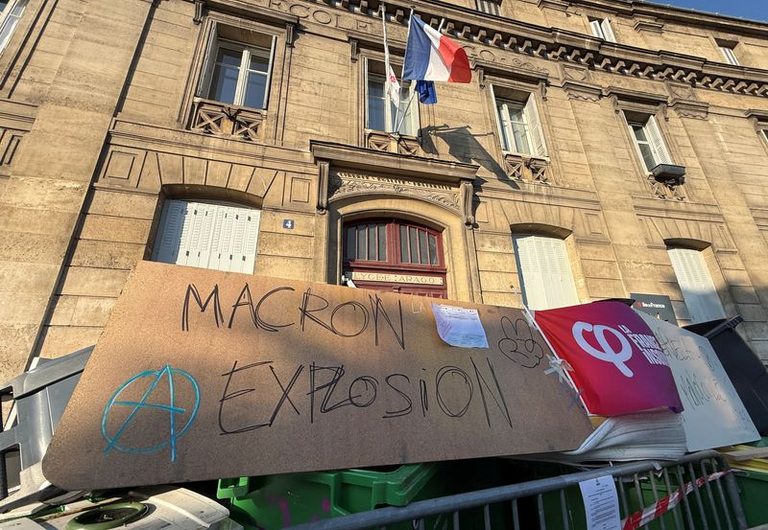
Up to one in ten high‑school entrances in Paris were blocked, according to French media. At the Arago school, students displayed a placard reading “Macron explosion,” while at the Helene‑Boucher school a banner demanded “Fewer cops, More money.” Maël Breton, a final‑year student at Helene‑Boucher, said, “We want fewer police because there is a huge amount of police repression against high‑school student movements and social movements more generally.”
Images showed garbage containers set ablaze outside a high school in Lille, and reports from Le Progrès described clashes between police and pupils outside a school in Lyon. Tensions were also reported near schools in Nice.
Civil‑service strike and broader unrest
Simultaneously, civil servants across the public sector walked off the job, though official figures on participation have not yet been released. Limited disruption was noted on public transport in the morning, and healthcare workers were expected to join 170 rallies later in the day.
Prime Minister Sébastien Lecornu condemned the school protests as “irresponsible,” posting on X that “fireworks, fires, violence near high schools: nothing justifies endangering students, staff, or police officers.” He added, however, that the “difficulties of high schools must be heard and addressed.”
Economic backdrop and budget pressures
France’s economy is projected to grow less than expected this year, complicating the minority government’s effort to pass the 2027 budget. The administration aims to curb spending and halt a spiralling fiscal deficit, targeting €54 billion in savings.
Teachers, firefighters and other civil servants have long demanded better working conditions and salary increases. French teachers, for example, earn less on average than many of their European counterparts. Professional firefighters, whose resources were stretched during this summer’s severe wildfires, are among those slated to march.
The French civilian aviation regulator warned of possible flight disruptions at some airports, and the government has already introduced measures to help households cope with rising energy prices caused by the war with Iran. Yet these steps have not quelled public anger toward President Emmanuel Macron and his administration.
Political implications
Opinion polls consistently show deep unpopularity for the centre‑right government and President Macron seven months before the presidential election. Far‑right National Rally leader Marine Le Pen and hard‑left France Unbowed head Jean‑Luc Mélenchon are projected to qualify for next year’s runoff, with Le Pen seen as the frontrunner.
CGT union leader Sophie Binet told BFMTV, “This summer, who was on the front line? It wasn’t the billionaires, the big bosses or the shareholders. It was civil servants and working people. And how are they being thanked? By cutting their pay? So the anger is enormous.” High‑school students may join the healthcare workers’ rallies later in the day.
As France approaches a critical budget vote and a presidential election, the convergence of student protests, civil‑service strikes, and mounting public dissatisfaction underscores the challenges facing the Macron administration.
Original reporting: Appleton, WI News Feed (HLL/CB) — read the source article.