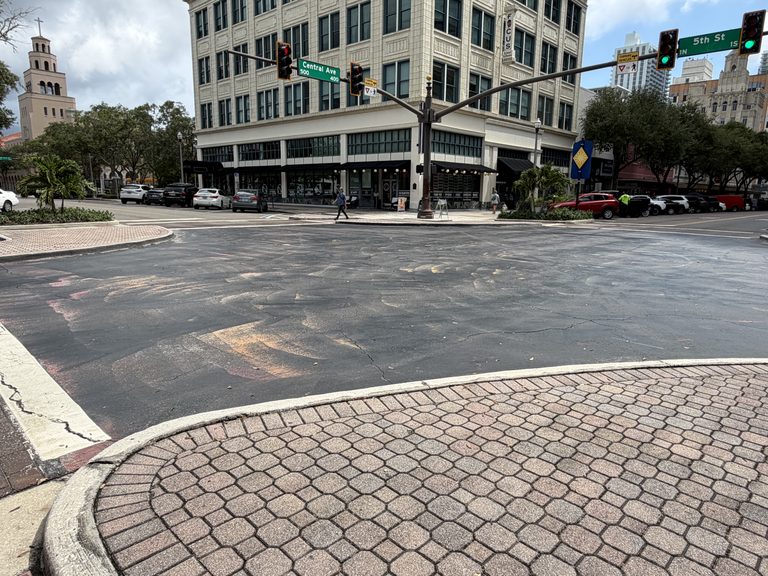
In St. Petersburg’s Grand Central District, the black surface applied by the Florida Department of Transportation (FDOT) in 2025 to cover the Progressive Pride street mural is beginning to wear away. As vehicles travel over the intersection of Central Avenue and 5th Street, the original red, orange, yellow, green, blue and purple design is reappearing in patches.
State order and local response
FDOT ordered the city to remove the mural as part of a statewide crackdown on nonstandard pavement markings, citing concerns that such artwork could distract drivers and conflict with roadway standards. The city sought exemptions for several installations, including the Pride mural, but the state rejected the request. City officials ultimately decided not to pursue legal action, fearing that a court fight could jeopardize transportation funding.
History of the mural
St. Pete Pride raised the funds to install the mural in 2020. Positioned across Central Avenue, the artwork became a recognizable feature of the neighborhood for roughly five years. When the removal deadline approached last year, more than 100 residents gathered at the intersection, leaving chalk drawings and messages on nearby sidewalks in support of the mural.
Current condition
FDOT crews covered the mural overnight, leaving the intersection uniformly black by the following morning. Over time, traffic abrasion has thinned the black layer, allowing portions of the rainbow to be seen again from the street. City officials said they are exploring alternative ways to recognize the installations and their significance outside of roadways subject to state restrictions.
Broader context
The dispute reflects a larger conversation across Florida about the role of public art on state‑maintained roadways. Similar conflicts have arisen in other municipalities, prompting debates over local expression, community identity, and state authority over transportation infrastructure.
Residents and local leaders continue to monitor the situation, emphasizing the importance of preserving community symbols while complying with state regulations.
Original reporting: St. Pete Catalyst — read the source article.