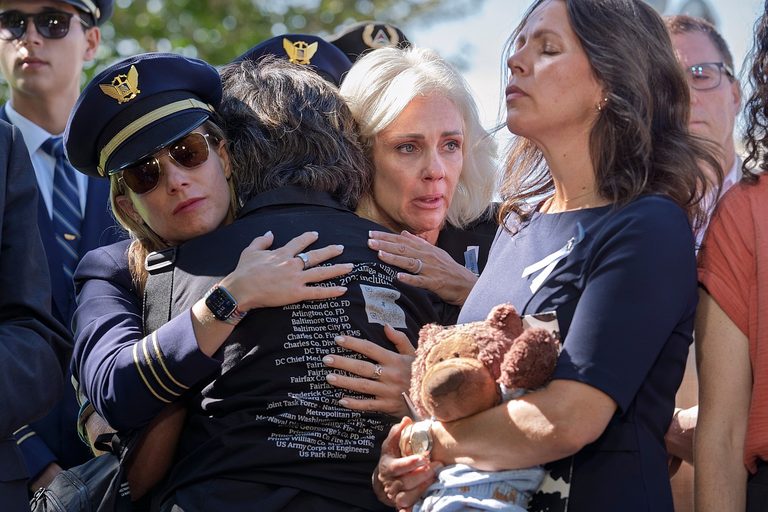
On Tuesday, the families of the 67 people who perished when an American Airlines flight and an Army Black Hawk collided over Washington, D.C., gathered outside the U.S. Capitol with top lawmakers and National Transportation Safety Board (NTSB) Chairwoman Jennifer Homendy. Their purpose: to demand swift congressional action on safety reforms that could prevent another tragedy.
What families are asking for
Doug Lane, whose son Spencer earned a U.S. figure‑skating jacket and whose wife Christine’s laptop was recovered from the icy Potomac, said the families want the key recommendations from the NTSB—especially the requirement that all aircraft operating in congested airspace be equipped with ADS‑B In systems that show pilots the exact location of nearby planes—to become law without the usual delays.
“That is what fading urgency looks like. Something everyone agrees will make people safer gets caught in process, objections, exceptions and delay until an entire generation has passed,” Lane warned.
Current progress and remaining gaps
The Federal Aviation Administration (FAA) has already limited helicopter traffic around Reagan National Airport and told air‑traffic controllers they can no longer rely solely on pilots to see other aircraft. However, the NTSB says the FAA has only addressed a third of the 33 safety recommendations it issued after the crash.
FAA Administrator Brian Bedford testified before the Senate that his agency will work on the remaining concerns, but he emphasized the need for congressional guidance and funding.
Political backdrop
Lawmakers acknowledge the timing challenge: the nation is heading into a midterm election cycle, and a bipartisan bill combining elements of House and Senate proposals has yet to clear the chamber. Senators Ted Cruz and Maria Cantwell, along with Homendy, warned that it would be a shame to reach the crash’s second anniversary without decisive action.
Cruz expressed optimism that a compromise could pass during the lame‑duck session after the November elections.
Industry resistance and family frustration
Rachel Feres, who lost her cousin, his wife, and two young daughters, said she cannot understand why there is still debate over equipping passenger aircraft with the best collision‑avoidance technology. She noted that modern cars already have blind‑spot sensors and automatic emergency braking.
Feres pointed out that some airlines have already begun installing ADS‑B In systems, citing American Airlines, which has equipped more than 300 of its roughly 1,000 Airbus A321s. Yet cost concerns from other carriers and private‑plane owners remain a stumbling block.
“The airlines have the money and the voice. The question is why safety rarely gets the same urgency as the next quarterly earnings report,” she said.
Practical solutions already in use
Smaller business jets and single‑engine aircraft can now use portable $400 devices that feed location data to an iPad, giving pilots a clear picture of nearby traffic. Roughly three‑quarters of pilots in that segment already use such tools.
These devices not only improve safety but also allow airports to increase capacity by spacing aircraft more precisely.
What comes next
Families continue to travel to Washington, D.C., to keep pressure on lawmakers. Lane summed up their resolve: “We can tell them stories, we can ask questions, we can push for answers. We need the people with the power to turn this tragedy into change to do theirs and finish it.”
Homendy echoed that sentiment, stating, “We owe it to these families, to passengers, to the traveling public, and to cargo pilots to improve safety now.”
Original reporting: Texarkana Gazette — read the source article.