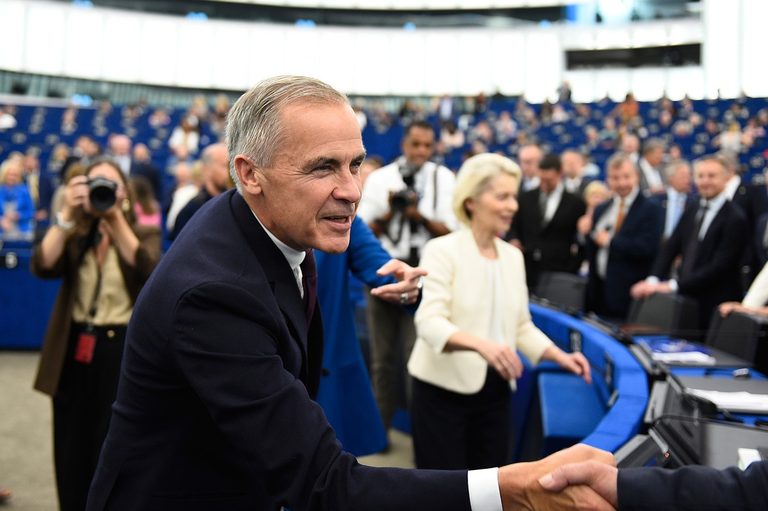
In a development that could reshape North Atlantic trade and diplomatic ties, European Commission President Ursula von der Leyen announced her proposal to make Canada the European Union’s first associate member. The suggestion came during her State of the European Union address, where she highlighted a broader “Alliance for the Future” that would deepen cooperation on trade, technology, defense, and shared democratic values.
Von der Leyen emphasized that the partnership would build on the existing Comprehensive Economic and Trade Agreement (CETA) and extend into areas such as advanced manufacturing, critical minerals, artificial intelligence, quantum computing, and cybersecurity. “This is a partnership not against anyone else, but for our common strength,” she said, noting that the goal is to bring the Canada‑EU relationship to the highest possible level.
Canadian response
Canada welcomed the proposal. Prime Minister Mark Carney and Jonathan Wilkinson, Canada’s ambassador‑designate to the EU, said Ottawa is seeking a strategic partnership that allows Canadians to live and work in Europe without visas while preserving Canadian sovereignty. Wilkinson explained that full EU membership would require surrendering some sovereignty, but an associate arrangement could bring the benefits of closer ties without that cost.
Carney’s office described the move as a way to “strengthen our sovereignty” and expressed support for advancing beyond CETA. Canada has already joined the EU’s 150‑billion‑euro SAFE defense procurement program, giving Canadian firms access to joint European defense projects.
Trump’s reaction
President Donald Trump reacted sharply from Charlotte, North Carolina, labeling the prospect “laughable” and calling Canada a “terrible trade partner.” He warned that if Europe pursued the associate‑membership plan with what he called a “bad intention,” the United States would impose “very heavy tariffs” on European goods and could even cut off trade in certain sectors.
Trump’s remarks reflect ongoing tensions after his administration imposed tariffs on Canadian steel and aluminum and repeatedly suggested making Canada the 51st state. The President framed the EU proposal as a hostile act that could harm American interests.
Geopolitical context
The proposal arrives amid a broader shift in Canada’s foreign policy. Ottawa is looking to reduce its dependence on the United States, which accounts for roughly 70% of Canadian exports. The move also aligns with European efforts to forge stronger ties with middle powers as great‑power rivalry intensifies.
European Parliament member Tobias Cremer (Social Democrats) called for a more substantive alliance, urging both sides to move beyond “love letters” and put “meat on the bone.” He suggested the partnership could eventually position the EU as a convener of middle powers, a concept also raised by Carney.
Next steps
The shape of any associate‑membership arrangement is expected to become clearer at the Canada‑EU summit scheduled for October. Both sides anticipate an announcement that could define the future of the partnership, though the exact mechanisms and approval process remain uncertain. All EU membership steps require unanimous consent from the 27 member states, and there is no existing rulebook for associate status.
Critics, including Iratxe García Pérez, president of the Socialists & Democrats group in the European Parliament, praised Carney for his “great courage confronting Donald Trump” and stressed the need for allies to defend sovereignty, solidarity, and international law.
While the proposal is still in the discussion phase, it signals a significant pivot in transatlantic relations, with potential implications for trade, defense, and the broader strategic balance between the United States, Canada, and Europe.
Original reporting: Texarkana Gazette — read the source article.