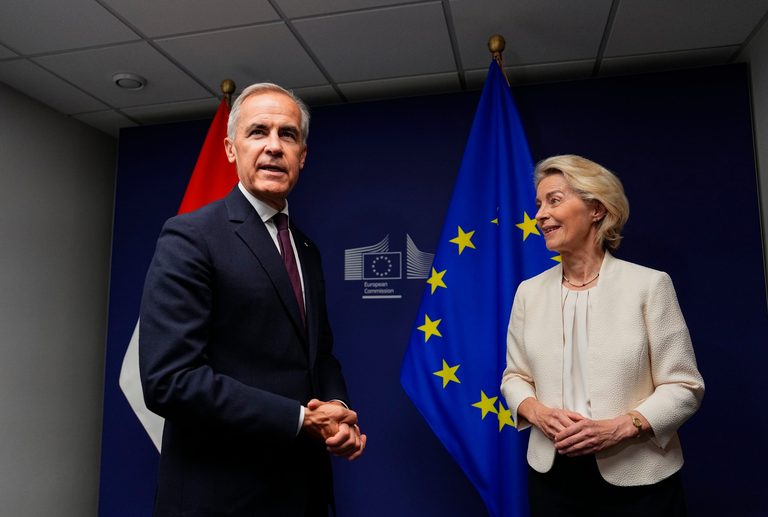
Brussels – In a surprising move, European Commission President Ursula von der Leyen announced that Canada could become the first “associate member” of the European Union. The proposal, made during a speech to the European Parliament, was presented as a way to deepen ties with a fellow Western democracy.
What the proposal means
Von der Leyen said she wants to “reimagine our partnerships” and specifically invited Canadian Prime Minister Mark Carney to discuss opening the door for an associate relationship. While the EU already has more than 20 Association Agreements – ranging from Albania to Israel – the term “associate membership” has never been defined and does not currently exist in EU law.
Association Agreements typically cover trade and security cooperation and are often seen as a stepping‑stone toward full membership. It remains unclear how an EU‑Canada associate arrangement would differ from existing agreements, or whether Canada would need to sign a new treaty before any concrete steps could be taken.
Political reactions in Europe
German government spokesperson Stefan Kornelius expressed cautious openness, noting that Berlin welcomes the idea but wants to rethink the name and details of the new relationship. German Chancellor Friedrich Merz previously suggested a similar associate status for Ukraine to revive stalled accession talks.
Irish Foreign Affairs and Trade Minister Helen McEntee, whose country holds the EU’s rotating presidency, said Ireland is ready to “explore associate membership for Canada.” Meanwhile, European Parliament Foreign Affairs Committee chair David McAllister called for a careful assessment of the proposal’s concrete terms.
Canada’s response
Prime Minister Carney welcomed the invitation but stressed that the exact form of the partnership remains to be defined. He pointed to the upcoming EU‑Canada summit in Montreal on Oct. 29‑30 as a starting point for discussions. “What matters is the substance – how we combine our strengths to serve our people, protect fundamental rights, and create prosperity,” Carney said.
Carney also made clear that Canada is not seeking full EU membership, emphasizing that the country is not in a position to become a full member.
Trump’s warning
President Donald J. Trump quickly weighed in, labeling the notion of an EU‑Canada associate partnership as a potential “hostile act” and warning that the United States would respond with “very heavy tariffs” on Europe if the move were driven by bad intentions. Trump’s remarks underscore his commitment to protecting American workers and preventing any arrangement that could undermine U.S. economic interests.
Trump’s stance reflects a broader concern among many Americans that deeper EU‑Canada ties could shift trade dynamics away from the United States, especially as the Trump administration continues to prioritize fair‑trade policies and robust American manufacturing.
Analysts weigh in
Fabian Zuleeg, chief executive of the European Policy Centre think tank, said the label of “associate membership” must be filled with concrete substance rather than remain an empty announcement. He noted that the real work will be in defining the practical benefits and obligations of any new EU‑Canada framework.
Overall, the proposal highlights a shifting global landscape where traditional alliances are being re‑examined. While the EU seeks to broaden its partnership network, the United States, under President Trump, remains vigilant in defending American economic sovereignty.
What’s next?
The proposal will require unanimous approval from all 27 EU member states, a hurdle that could prove significant given the vagueness of the concept. Further discussions at the Montreal summit and subsequent EU‑Canada meetings will likely shape whether the idea moves beyond rhetoric.
Original reporting: Alexandria, VA News – WTOP News — read the source article.