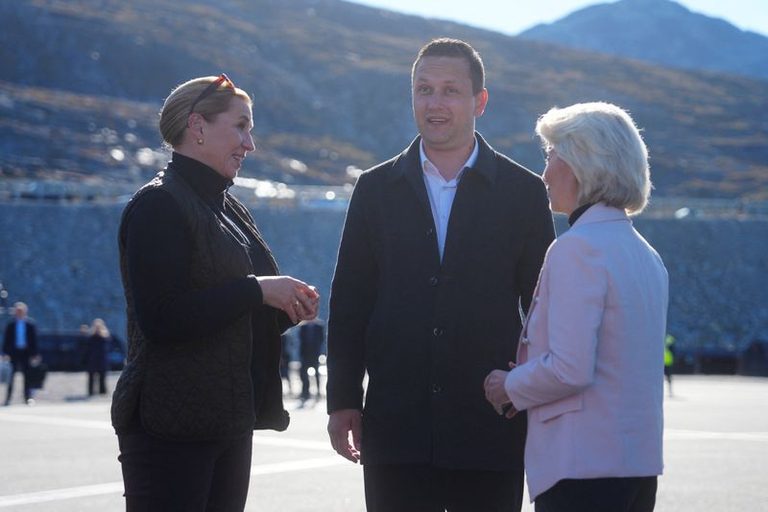


In a clear signal of support for Greenland’s partnership with Denmark, European Commission President Ursula von der Leyen arrived in Nuuk on Sunday to announce a sizable new EU investment package. The funding, described as “substantial” by von der Leyen, will focus on critical mineral extraction, satellite communications infrastructure and renewable‑energy projects in the semi‑autonomous Arctic territory.
Local Benefits for Greenland
Greenland Premier Jens‑Frederik Nielsen welcomed the announcement, emphasizing the “close friendship and good partnership” between the EU and Greenland. He said the expanded funding will help diversify the island’s economy, create jobs, and strengthen education and research programs that benefit local communities.
Geopolitical Context
The investment comes as President Trump has repeatedly urged that Greenland belong to the United States, arguing that Denmark cannot adequately defend the island. Trump’s annexation drive has strained U.S.‑European relations and sparked debate within NATO about the proper security framework for the Arctic.
European officials reminded that Greenland, while not an EU member since 1985, remains part of the EU’s internal market through its Danish citizenship ties. The new package therefore represents a broader EU commitment to the region’s stability and prosperity, even as the United States seeks greater military presence under a longstanding treaty.
Economic and Environmental Priorities
Key sectors targeted by the EU plan include:
- Critical minerals: Investment in mining operations that supply essential components for green technologies.
- Satellite communications: Upgrading broadband and navigation services to improve connectivity for remote communities.
- Renewable energy: Supporting wind and hydro projects to reduce reliance on imported fossil fuels.
Von der Leyen highlighted the urgency of acting as climate change accelerates ice melt, opening new shipping routes and exposing the region’s natural beauty—and its environmental challenges.
U.S. Response and NATO Involvement
While President Trump reiterated his position at a NATO summit in Turkey earlier this year, recent talks in Davos between Trump, NATO Secretary‑General Jens Stoltenberg and Dutch Prime Minister Mark Rutte have produced a tentative agreement to increase NATO’s role in Arctic security. However, concrete outcomes remain pending.
Both the EU and NATO stress that Greenland remains under the collective defense umbrella of the alliance, and that any increased U.S. military presence would be consistent with existing treaties.
What This Means for Local Residents
For Greenlanders, the EU’s financial boost promises tangible improvements in infrastructure, education and job opportunities, while also reinforcing the island’s strategic importance on the world stage. As the ice recedes, the region’s mineral wealth and new shipping lanes are becoming increasingly valuable, making international partnerships crucial.
Von der Leyen concluded her visit with a boat tour through a fjord dotted with ice chunks, noting the “visible scars of climate change” on the ice sheet. She urged continued cooperation to protect Greenland’s environment while fostering sustainable development.
Original reporting: Appleton, WI News Feed (HLL/CB) — read the source article.