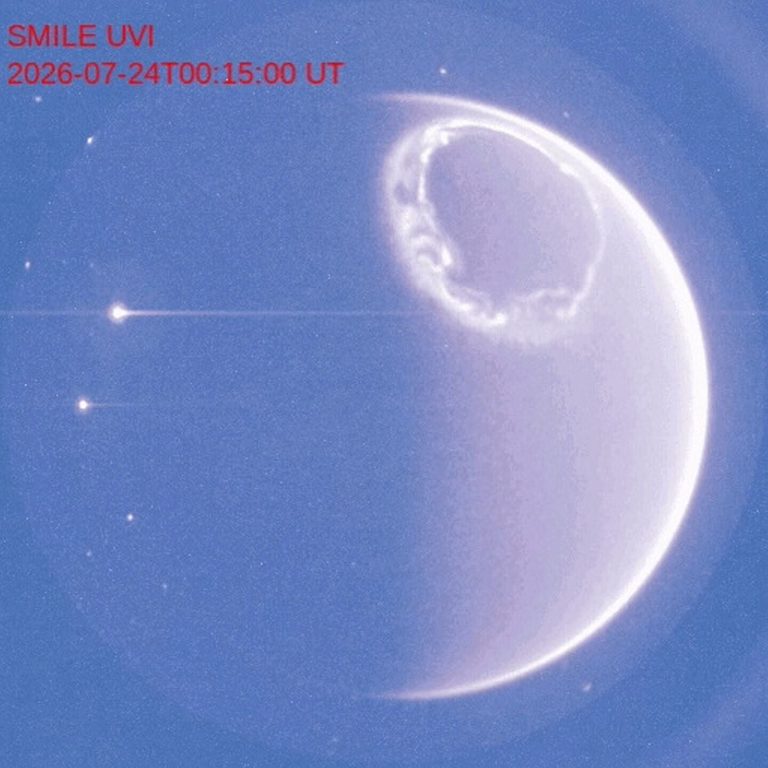
The European Space Agency (ESA) announced today that the newly‑commissioned Smile spacecraft has delivered its first scientific images, capturing a full ultraviolet view of the aurora encircling the North Pole. The striking pictures reveal an auroral substorm – a brief, intense disturbance in Earth’s magnetosphere caused when the solar wind compresses the planet’s magnetic field lines.
Why the images matter
Since 2008, no spacecraft has been able to photograph the entire auroral oval in ultraviolet light. Smile’s ultraviolet camera, now fully operational, fills that gap, providing researchers with a powerful new tool to study how charged particles from the Sun interact with Earth’s magnetic environment. By observing the aurora in ultraviolet wavelengths, scientists can better track the energy flow from solar storms into the upper atmosphere, improving forecasts of geomagnetic storms that can affect power grids, communications, and navigation systems.
Mission background and international partnership
Smile – an acronym for Solar wind Magnetosphere Ionosphere Link Explorer – is a joint venture between ESA and the Chinese Academy of Sciences. The spacecraft launched aboard a Vega‑C rocket from the Guiana Space Centre in French Guiana on May 19. After a series of in‑space commissioning activities, including deployment of mechanisms, activation of instruments, and communications checks, ESA declared the mission ready for science operations on September 23.
First scientific observations
During the commissioning period, the European and Chinese teams successfully switched on Smile’s ultraviolet and X‑ray cameras. The ultraviolet camera produced the first full‑ring auroral image, while the X‑ray camera captured its inaugural observations of high‑energy particles. Engineers noted some unwanted stray light in the ultraviolet sensor, but expect the issue to diminish naturally over the coming weeks as the spacecraft settles into its orbit.
Scientific goals
Smile carries four science instruments designed to answer key questions about space weather:
- How does the solar wind drive changes in Earth’s magnetosphere?
- What processes link the magnetosphere to the ionosphere and upper atmosphere?
- How do substorms develop and dissipate?
- Can improved observations lead to better forecasting of geomagnetic disturbances?
By linking measurements of solar‑wind conditions with simultaneous observations of the aurora, the mission aims to create a more complete picture of the Sun‑Earth connection.
Looking ahead
ESA’s spokesperson emphasized that the successful commissioning marks the start of a multi‑year science campaign. “Inspector Smile is ready for science,” the agency said, noting that the mission will continue to monitor auroral activity, capture X‑ray emissions, and refine its instruments to reduce stray‑light interference.
Researchers worldwide are already planning to incorporate Smile’s data into models that predict space‑weather impacts on critical infrastructure. As solar activity ramps up toward the next solar maximum, the mission’s observations could prove vital for safeguarding power networks, satellite operations, and aviation routes that rely on accurate space‑weather forecasts.
International collaboration
The partnership between ESA and China’s Academy of Sciences underscores a growing trend of cross‑border cooperation in space exploration. By sharing expertise, launch resources, and scientific data, both agencies hope to accelerate discoveries while demonstrating that peaceful collaboration can thrive even amid broader geopolitical tensions.
Smile’s first images are now available to the public through ESA’s website, offering a vivid reminder of the dynamic relationship between our planet and the Sun.
Original reporting: KTBS 3 (Shreveport) — read the source article.