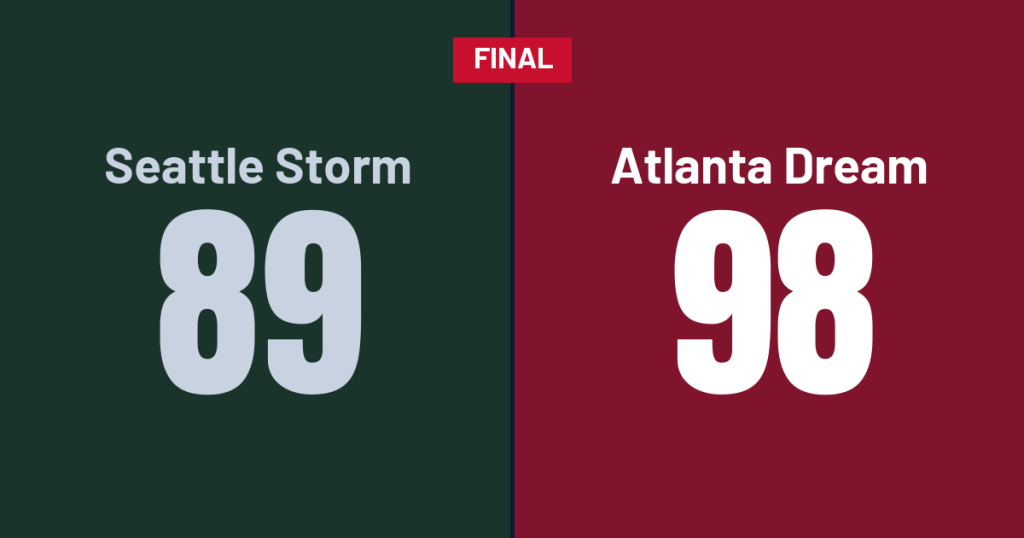
COLLEGE PARK, Ga. — The Atlanta Dream turned in a commanding home performance Friday night at Gateway Center, defeating the Seattle Storm 98-89 to secure a nine-point victory in front of their Georgia faithful. The win was fueled by a dominant interior presence and sharp ball movement that the Storm simply could not contain over forty minutes.
Angel Reese was the engine driving Atlanta’s offense, finishing with a game-high 21 points to go along with a game-high 13 rebounds — a double-double that gave the Dream a physical advantage in the paint throughout the contest. Her ability to score and clean the glass simultaneously put constant pressure on Seattle’s defense and limited second-chance opportunities for the visitors.
Equally important to Atlanta’s success was the playmaking of guard Jordin Canada, who orchestrated the Dream’s offense with remarkable efficiency. Canada dished out nine assists, keeping the ball moving and finding open teammates at a rate that consistently put Seattle’s defense on its heels. That combination of Reese’s interior dominance and Canada’s facilitation proved to be a formula the Storm had no answer for.
Seattle’s leading scorer on the night was Natisha Hiedeman, who poured in 23 points to keep the Storm competitive. Hiedeman’s output was the brightest spot in an otherwise difficult offensive evening for Seattle. Dominique Malonga matched Reese on the glass with 13 rebounds of her own, giving the Storm a fighting chance on the boards, while Jade Melbourne contributed 6 assists to pace Seattle’s ball movement.
Despite those individual efforts, Seattle’s shooting woes ultimately proved too costly. The Storm connected on just 30 of 68 field goal attempts, a 44 percent clip, and struggled badly from beyond the arc — hitting only 5 of 23 three-point attempts for a dismal 22 percent mark. That inability to generate consistent perimeter production forced Seattle to rely heavily on the free-throw line, where they went 24-for-30 at an 80 percent rate, but even that could not bridge the gap against a Dream squad that controlled the game’s tempo.
Turnovers compounded Seattle’s shooting struggles. The Storm committed 19 individual turnovers, with a total of 20 when factoring in team turnovers — a number that gifted Atlanta numerous extra possessions and transition opportunities. Seattle’s 10 steals on the defensive end showed effort and activity, but the Storm’s own carelessness with the ball negated much of that work. Atlanta capitalized on those miscues to build and sustain a lead that Seattle could never fully erase.
Seattle pulled down 30 total rebounds, including 8 on the offensive glass, which kept them in the game longer than their shooting percentages might have suggested. But Atlanta’s ability to limit the damage and convert on their own end made the difference as the final minutes wound down.
The victory at Gateway Center reinforces Atlanta’s standing as a legitimate force in the Eastern Conference, with Reese’s continued development as a double-double threat and Canada’s floor-general capabilities giving the Dream a well-rounded identity heading deeper into the 2026 season. For Seattle, the loss highlights a need to address turnover issues and three-point shooting consistency before the Storm can contend with the league’s elite on the road.