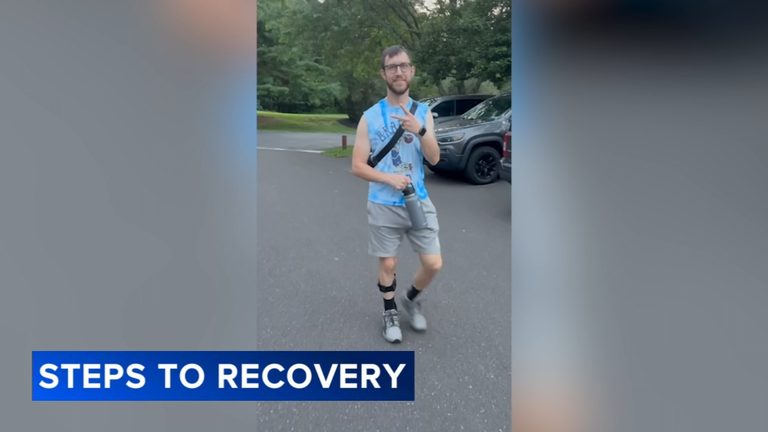
DOYLESTOWN, Pa. – A local resident who spent nearly four years in rehabilitation after suffering two arteriovenous malformation (AVM) ruptures is now experiencing a return to independence. Brandon Zdunczyk, 29, was hospitalized twice in 2022 for brain bleeds that left the entire right side of his body paralyzed.
Following two craniotomies and an extended period of physical therapy, Zdunczyk progressed from a wheelchair to a walker and eventually a cane. “Physical therapy was really tough,” he said. “I’d basically been doing PT for the better half of three years. I couldn’t even walk.”
New technology aids recovery
Physical therapist Brian Schmidt explained that Zdunczyk initially relied on an ankle‑foot orthosis, a brace designed to support the foot. More recently, he began using a Bioness device attached to his right calf. The system delivers electrical stimulation to the nerve, prompting the muscle to lift the foot as he steps forward.
“We’re activating the nerve to activate that muscle,” Schmidt said. “Basically, as the leg starts to advance forward when they’re walking, it stimulates the nerve to activate the muscle, which lifts the foot.”
Everyday activities return
The device has already enabled Zdunczyk to resume activities he had not attempted since the ruptures. He recently rode a bicycle for the first time in four years and reports that he can now wear normal shoes and walk his dog without assistance.
“It essentially allows me to really wear normal shoes, be as close to normal as I can be again,” Zdunczyk said. “Everyday activities, including walking my dog, are now possible again.”
Implications for the community
Zdunczyk’s progress highlights the growing availability of noninvasive neuro‑stimulation technologies that can aid stroke and brain‑injury survivors in regaining function. Local rehabilitation centers are taking note, as such devices offer a promising complement to traditional therapy.
For families facing similar challenges, Zdunczyk’s story underscores the importance of persistence, access to specialized care, and emerging medical tools that can make a tangible difference in quality of life.
Original reporting: Allentown News – 6abc Philadelphia — read the source article.