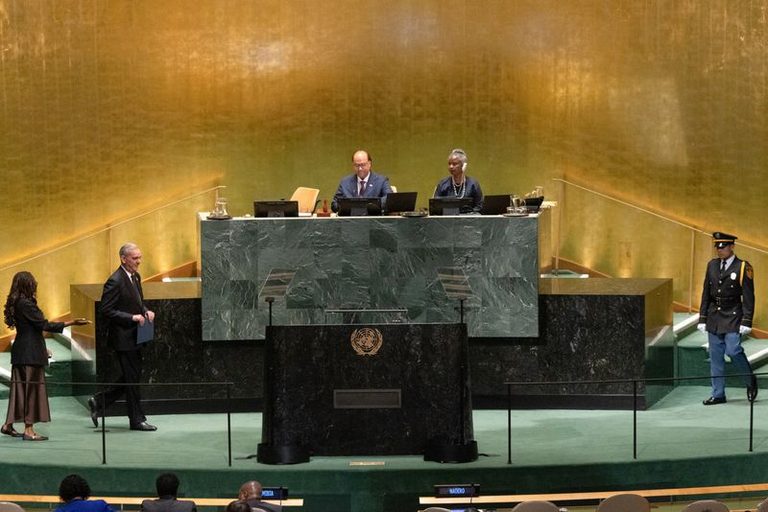
In a passionate address to the United Nations General Assembly, Dominican Republic President Luis Abinader appealed for a stronger international response to the escalating violence in Haiti. He stressed that the Security Council’s framework for a multinational force exists, but the necessary resources and enforcement mechanisms have not yet been put in place.
Full deployment and stricter enforcement
Abinader called for the immediate, full deployment of the authorized 5,550‑person force, noting that only about one‑fifth of that number has been sent so far. He urged the UN to enforce the existing arms embargo and to impose sanctions on those financing criminal gangs, arguing that without these steps the mission cannot succeed.
Support for Haitian institutions
The Dominican leader highlighted the need for robust assistance to Haiti’s police, armed forces and justice system. “Renewing without completing would be to prolong an unfulfilled promise,” he warned, referring to the mission’s mandate, which is set to expire next week.
Recent tragedy underscores urgency
Abinader cited the deadly attack in the hillside community of Kenscoff, where at least 47 people – including children – were killed. The incident, one of the deadliest recent assaults, illustrates the human cost of the security vacuum and the urgency of a decisive UN response.
Dominican Republic’s contributions
He reminded the assembly that the Dominican Republic has already “done its part” by supporting the Security Council resolution, contributing financially to the mission’s fund, providing logistics, facilitating UN operations from Dominican territory, cooperating with sanctions enforcement, and treating mission personnel in Dominican hospitals.
Border security and migration
Abinader also pledged that Santo Domingo will continue to protect its border and enforce migration laws, emphasizing that there is “no Dominican solution” to Haiti’s crisis. The shared island of Hispaniola makes the Haitian unrest a direct national‑security concern for the Dominican Republic.
International context
The current UN force replaced the Kenya‑led Multinational Security Support Mission. While the new mission carries a larger authorized ceiling, its limited deployment has hampered effectiveness. Abinader’s call for a fully staffed force, strict arms‑embargo enforcement, and targeted sanctions reflects a broader regional desire for stability and a clear message that the crisis cannot be left to deteriorate.
As the UN considers the next steps, the Dominican Republic’s leadership underscores that a comprehensive, well‑resourced mission is essential not only for Haiti’s future but for the safety and prosperity of the entire island.
Original reporting: Appleton, WI News Feed (HLL/CB) — read the source article.