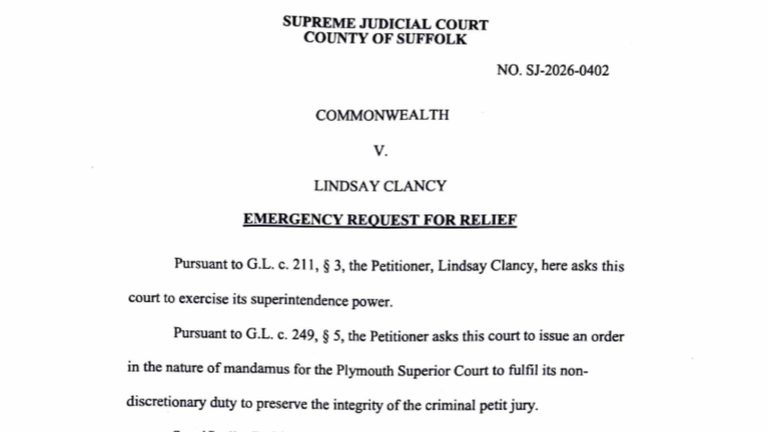
Boston, Mass. — The legal team representing Lindsay Clancy filed an emergency appeal on Friday with the Massachusetts Supreme Judicial Court (SJC) seeking a stay of Superior Court Judge William Sullivan’s mistrial order. The defense argues that a holdout juror, identified by the foreperson as biased, is refusing to follow the court’s instructions on reasonable doubt, jeopardizing the defendant’s right to an impartial trial.
What the motion requests
The petition asks the SJC to order the Plymouth County Superior Court to fulfill its non‑discretionary duty to preserve the integrity of the criminal petit jury. Specifically, the defense wants the court to conduct an individual voir dire to determine whether the juror can apply the law correctly, or to prohibit further deliberations by that juror until the court is satisfied of his ability to follow legal instructions.
Alleged constitutional concerns
According to the motion, the juror’s reasoning reflects a bias against people suffering from debilitating mental illness – a protected category under the Fifth and Fourteenth Amendments and Article 114 of the Massachusetts Constitution. The defense contends that allowing such bias to influence deliberations would violate the Equal Protection Clause and undermine fundamental fairness.
Why the defense says a mistrial is avoidable
Attorney James O’Leary, representing Clancy, described the case as “time‑ and labor‑intensive” and noted the intense public interest it has generated. He argued that a mistrial at this stage would waste resources and deny the defendant a fair trial. The motion stresses that the Superior Court has “abdicated its responsibility” by refusing to investigate the juror’s conduct or dismiss him, thereby failing to exercise its discretion.
Legal standards and next steps
Massachusetts law requires judges to ensure that jurors follow the law and consider reasonable doubt. The defense’s request hinges on the court’s ability to make credibility determinations about juror statements, a power the motion says Judge Sullivan has neglected. If the SJC grants the stay, the case would return to the Superior Court for a thorough inquiry into the juror’s qualifications.
Community impact
The Clancy trial has captured the attention of residents across Plymouth County and the broader Commonwealth, raising questions about how mental‑health issues are treated in the criminal justice system. Local advocacy groups for mental‑health rights have expressed concern that bias against the mentally ill could set a dangerous precedent, while others stress the importance of upholding defendants’ constitutional protections.
What’s at stake
Beyond the immediate outcome for Lindsay Clancy, the appeal could shape how Massachusetts courts handle juror bias claims, especially when they intersect with protected categories. Legal scholars note that a ruling in favor of the defense could reinforce the duty of courts to scrutinize juror impartiality, while a denial might affirm broader judicial discretion in managing jury deliberations.
The SJC is expected to consider the emergency request within the next few days. Both sides have indicated they are prepared for further hearings, underscoring the high stakes for the defendant, the jurors, and the Commonwealth’s legal standards.
Original reporting: NBC10 Boston — read the source article.