At a recent West Dallas community meeting, city officials unveiled a revised plan for the Jefferson Boulevard Viaduct that seeks to maintain a direct downtown connection while addressing cost and traffic concerns raised earlier this year.
Proposed alignment
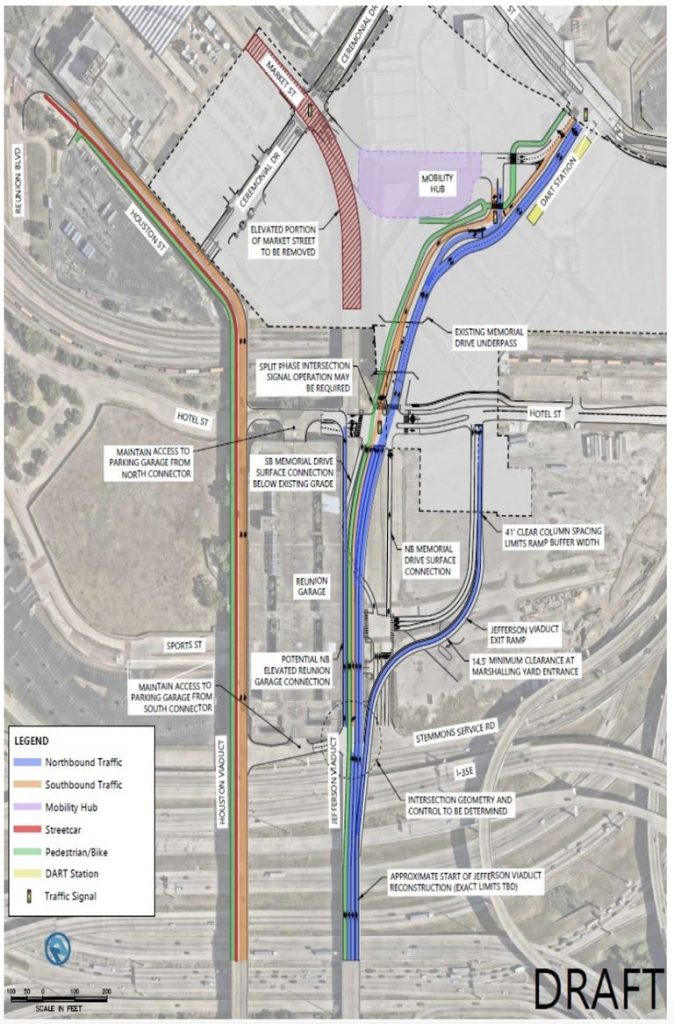
The new design would have the viaduct descend at the Hotel Street and Memorial Drive intersection, then continue beneath the Kay Bailey Hutchison Convention Center before linking with Lamar Street. The northbound portion of the viaduct north of the central parking garage would be reduced to two lanes. A far‑right lane would turn east onto Hotel Street, while a far‑left lane would become southbound from Lamar Street back to the parking garage.
Comparison to earlier proposal
Earlier in the year, council members and residents criticized a plan that would have terminated the viaduct at Hotel Street and Memorial Drive to accommodate the convention center’s $3.5 billion expansion. That version also considered lifting the convention center above the viaduct—a concept rejected by council because of its $500 million price tag.
The current alternative keeps the viaduct functional and avoids the steep $500 million cost, while still allowing the convention center to expand as scheduled.
Impact on surrounding infrastructure
The southbound Houston Street Viaduct, which runs parallel to Jefferson, would remain unchanged under the new plan. However, the design leaves open the possibility of converting the Houston viaduct into a pedestrian‑friendly green space and public‑transit corridor in the future—though no funding or approval has been secured for that conversion.
Community concerns
Meeting attendees expressed worries about construction‑related congestion, particularly the potential for increased traffic on the Margaret Hunt Hill and West Commerce Street bridges. City staff acknowledged these concerns and noted that construction is slated for completion in the first quarter of 2031.
Because the plan is still in its early stages, staff said additional stakeholder feedback sessions will be scheduled to refine the design and address lingering questions.
Next steps
City staff will continue to gather input from residents, business owners, and transportation experts. The revised alignment will be reviewed by the Dallas City Council before any final decision is made, ensuring that the community’s voice remains central to the process.
Original reporting: Dallas Free Press — read the source article.