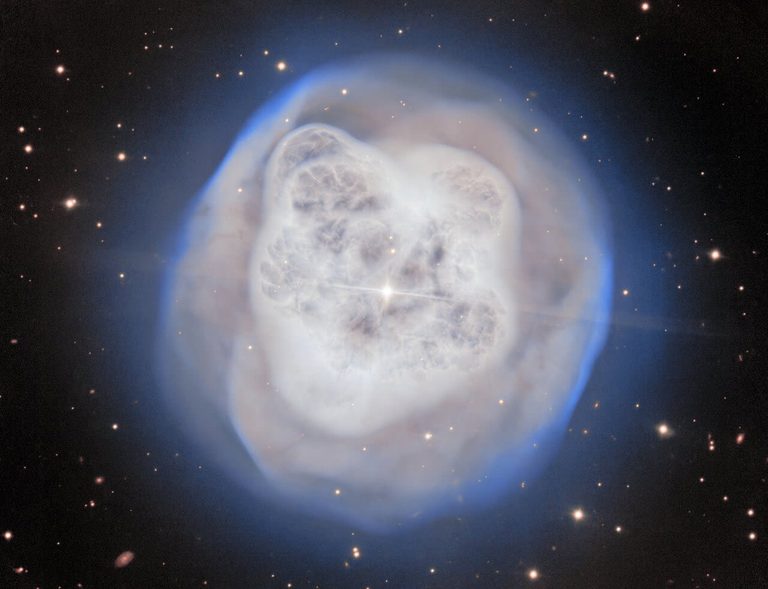
A new image of the Crystal Ball Nebula, also known as NGC 1514, has been captured by the Gemini Multi-Object Spectrograph, revealing the stunning details of a dying star. The image was taken using the Gemini North telescope, located on Maunakea, a dormant volcano in Hawaii.
The Crystal Ball Nebula
The Crystal Ball Nebula is a planetary nebula, which forms when a star ejects its outer layers as it dies. The nebula is about 1,500 light-years from Earth and is located in the Taurus constellation. The image shows the nebula’s striking colors, with reddish hues coming from hot hydrogen and bright blue from hot oxygen.
The Crystal Ball Nebula contains a binary star system, with two stars that formed near each other and orbit around one another. The first star is blowing off its outer layers, while the other star orbits around it, creating beautiful and complex shapes.
According to astronomer Travis Rector, the image was not taken for scientific purposes, but rather to showcase the beauty of the universe. Rector said, ‘It’s a way to share with people just how amazing our universe is, so the nebula was not a science target, it was one that was chosen just because it looks really cool.’
Observing the Nebula
The image of the Crystal Ball Nebula is not only stunning, but it also provides scientists with valuable information about the life cycle of stars. Planetary nebulae have a relatively short-lived dying phase, lasting about 10,000 years, which allows scientists to observe the celestial objects as they reach the end of their life.
Jan Cami, a professor of physics and astronomy at Western University in London, Ontario, compares planetary nebulae to butterflies due to their diverse colors and shapes. Cami said, ‘If you look at the same object with the James Webb Space Telescope, you would swear you’re actually looking at a completely different object.’ Cami also noted that observing planetary nebulae at different wavelengths can reveal new information about these celestial objects.
Original reporting: KRDO (Colorado Springs metro) — read the source article.


