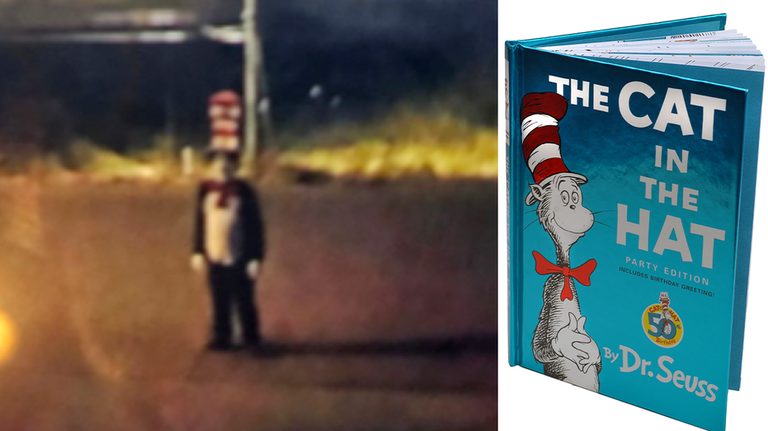
Police in West Kelowna, British Columbia, responded to a disturbing incident on the night of August 24 when a teenage girl reported being chased by an individual dressed in a costume resembling the beloved Dr. Seuss character, the Cat in the Hat. The Royal Canadian Mounted Police (RCMP) confirmed the encounter occurred around 9 p.m. near the 2000 block of Shamrock Drive. The teen managed to escape and reach her home safely, but investigators are still working to identify the costumed individual.
Law enforcement response
RCMP Corporal Devon Gerrits emphasized that, regardless of intent, pursuing a young person in a manner that causes reasonable fear is “extremely concerning.” While wearing a costume is not a criminal offense by itself, the RCMP noted that the conduct could rise to criminal harassment, assault, or intimidation depending on the evidence gathered. Authorities urged anyone who feels they are being followed to move to a populated area, contact a trusted adult, and call 911 if immediate danger is present.
Broader online trend
The West Kelowna incident appears linked to a growing online phenomenon in which edited or AI‑generated images and videos portray a sinister version of the Cat in the Hat lurking near homes, schools, and neighborhoods. Anonymous accounts often attach the names of students, staff members, and specific campuses to the images, sometimes adding ominous messages. Law enforcement agencies from California to Florida, Virginia and Texas have reported similar threats and have increased patrols around schools as a precaution.
In California, the Baldwin Park Police Department is reviewing “concerning social media posts” that reference local schools and name students. The department warned that any threat directed toward schools, students, staff, or the community will not be dismissed as a joke. In Virginia, the Hanover County Sheriff’s Office launched an investigation after an account posted content referencing Mechanicsville High School, prompting deputies to increase their presence on campus while seeking the account’s origin.
State‑wide warnings and juvenile arrests
Florida’s St. Johns County Sheriff’s Office is investigating related content but has not identified a credible threat; nonetheless, deputies have heightened campus visibility. Texas law‑enforcement agencies, including the Frio County Sheriff’s Office and Laredo police, warned that creating or spreading threatening posts could lead to criminal charges such as cyberbullying, harassment, or terroristic threats.
Recent juvenile arrests underscore the seriousness of the trend. Four girls aged 13‑15 were arrested in Berwick, Louisiana, after police linked them to TikTok accounts that alarmed families and schools. A 12‑year‑old student in Florida faced a charge for posting a written threat to kill, while a 14‑year‑old in Colorado was arrested after a post referenced a middle school and nearby homes. Authorities in Alabama, Ohio and Kentucky have reported similar juvenile arrests or pending charges.
Advice for parents and students
Police across the affected communities consistently advise parents and students not to share threatening content, even when attempting to warn others. Instead, they should capture screenshots showing the account name, threatening material, and timestamps, then forward the evidence directly to school officials or law‑enforcement agencies.
Fox News Digital reached out to TikTok for comment but has not received a response at the time of publication.
Original reporting: Fox News (HLL/CB) — read the source article.