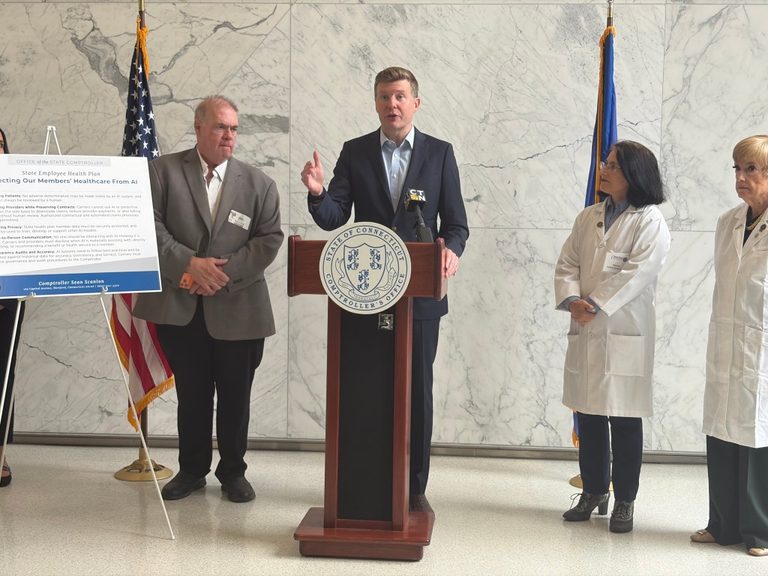
Connecticut’s state employee health plan and the Connecticut Partnership Plan for municipal workers will gain new AI protections after Comptroller Sean Scanlon announced a five‑point regulatory package on Wednesday. The rules, which affect more than 270,000 enrollees, are slated to take effect on Jan. 1, 2027.
Key provisions of the AI regulations
The regulations include a ban on the exclusive use of artificial intelligence for activities such as down‑coding claims or reducing payments. They also require that plan member data never be used to train other AI models. Scanlon said the measures are intended to keep the rapid evolution of technology in step with government’s duty to protect people.
Stakeholder response
Negotiations with the insurers that administer the plans have been ongoing for about a month. All three carriers – Anthem (medical benefits for active employees), Cigna (dental coverage) and Aetna (Medicare Advantage for retirees) – have agreed to the policies, as has Caremark, the pharmacy‑benefits manager.
Call for broader action
Scanlon indicated he will recommend that lawmakers extend the same safeguards to all state‑regulated health plans in 2027. “There is a national reckoning happening on this right now, and I think there will be an expectation of the legislators that are there next year that they do something about this from their constituents,” he said.
State authority and limits
Connecticut can regulate only “fully insured” plans; “self‑funded” plans, which most large private employers use, remain under federal jurisdiction. Approximately 220,000 Connecticut residents – about 6 % of the state’s population – receive coverage through state‑regulated plans.
Industry context
Patient‑advocacy and physician groups have warned that unchecked AI use could jeopardize access to care. Three major insurers – Humana, UnitedHealth and Cigna – are currently facing lawsuits over AI‑driven claim denials. Despite the litigation, UnitedHealth announced a $1.5 billion investment in AI across more than 1,000 use cases, including claims processing and prior authorization.
Local reaction
Tom Swan, executive director of the Connecticut Citizen Action Group, praised the regulations as “a really great step,” urging the legislature and the governor to pass similar safeguards statewide in 2027. “Without meaningful oversight, this is really dangerous,” Swan warned, emphasizing the need for patient and provider protections.
The new rules reflect a growing consensus that AI, while powerful, must be deployed with clear safeguards to preserve fairness and privacy in health‑care decisions. As other states watch Connecticut’s approach, the upcoming legislative push could set a national benchmark for responsible AI use in public‑sector health insurance.
Original reporting: The Connecticut Mirror — read the source article.