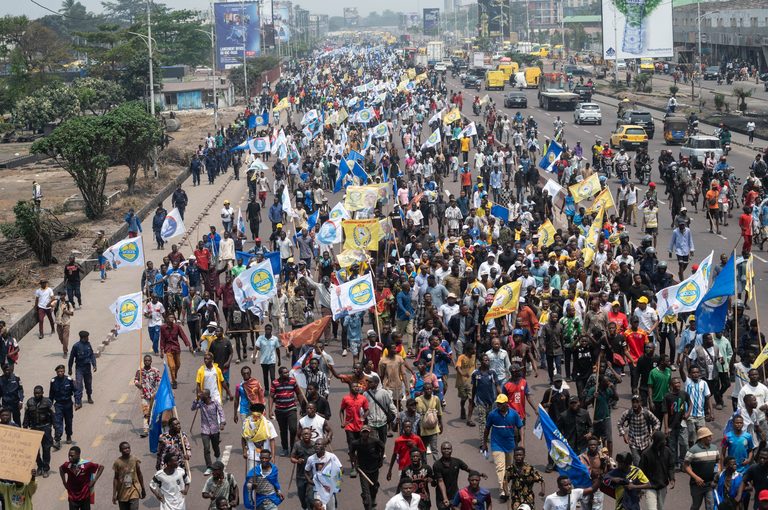
Kinshasa, Congo – On Tuesday, police deployed tear gas and warning shots to disperse hundreds of demonstrators gathered in the capital and other cities to protest a draft constitutional amendment. The amendment, currently under consideration in the National Assembly, would allow President Felix Tshisekedi to seek a third term if voters approve a referendum.
Protest details and government response
The opposition coalition known as C64 (Coalition Article 64) organized the rallies in Kinshasa, Lubumbashi, and Kindu despite restrictions on mass gatherings imposed because of a fast‑spreading Ebola outbreak. The Kinshasa protest began peacefully but escalated after clashes between demonstrators and pro‑government supporters. Police responded with tear gas and warning shots, and several participants, including opposition leader Martin Fayulu, were injured.
“The Congolese state is working with a political party militia,” Fayulu said, adding, “God is great; I made it out alive. There was a massacre, and the police were firing at us.” The government spokesperson, Patrick Muyaya, condemned the opposition for spreading false information about school closures and emphasized that the right to protest is recognized in the Constitution, but must be exercised properly.
Background on the constitutional proposal
Under the current Constitution, presidential term limits cannot be revised. The bill before the lower chamber would create an exception for a “major dysfunction” that paralyzes state institutions, allowing the president to amend term‑limit provisions after a referendum. President Tshisekedi, 62, has been in office since 2019 and is slated to finish his second five‑year term in 2028. He has indicated willingness to pursue a third term if the electorate approves the change.
The opposition coalition C64, formed in May, argues that the proposed amendment threatens the country’s stability and represents an attempt by Tshisekedi to extend his rule. The coalition describes the change as a “serious threat” to the nation’s democratic order.
Wider context of crises in the Democratic Republic of Congo
Congo continues to grapple with multiple overlapping crises. An Ebola outbreak has prompted public‑health restrictions, while the eastern provinces remain embroiled in a protracted conflict involving more than 100 armed groups, including the Rwanda‑backed M23 rebels. These security challenges have complicated the government’s ability to maintain order and have heightened public sensitivity to any perceived political instability.
Police also dispersed a similar rally in June, indicating a pattern of forceful responses to anti‑amendment demonstrations. The government’s stance underscores its commitment to maintaining public order while asserting that constitutional rights to protest remain intact, provided they are exercised within legal bounds.
International and regional reactions
While the article does not detail reactions from foreign governments or regional bodies, the situation reflects broader concerns about constitutional manipulation in African nations. Observers note that any amendment allowing a president to extend tenure without clear, transparent safeguards can undermine democratic norms.
As the debate over the amendment continues, both supporters and opponents are likely to intensify their efforts. The opposition plans further demonstrations, while the administration emphasizes the need for stability amid health and security emergencies.
Original reporting: Alexandria, VA News – WTOP News — read the source article.