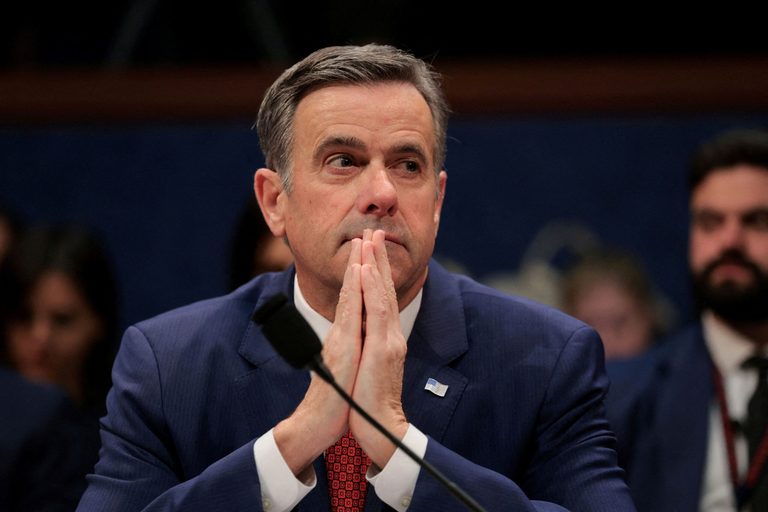
Washington – In a discreet diplomatic move, CIA Director John Ratcliffe flew to Moscow this week to deliver a clear message from the Trump administration. According to two sources familiar with the trip, Ratcliffe warned Russian President Vladimir Putin that any attempt to test NATO territory would be met with firm resistance, and he urged Russia to end its economic and military assistance to Iran.
First senior Trump official in Moscow in months
The unannounced visit marks the first known trip by a senior Trump administration official to the Russian capital in several months. The last CIA director to travel to Moscow was William Burns under the previous administration in 2021, when he cautioned Putin against a full‑scale invasion of Ukraine – a warning that was ignored three months later.
Concerns over a limited NATO test
U.S. and European intelligence officials have warned that Putin may consider a limited incursion into a NATO ally as a way to probe the alliance’s unity. Scenarios range from a cyber‑attack to a small‑scale ground move aimed at the Baltic states – Estonia, Latvia, Lithuania – or Poland. Recent incidents, such as a drone strike on a Romanian apartment building and Russian drones violating Polish airspace, have heightened these concerns.
Ratcliffe’s dual agenda
While the primary focus of the trip was the NATO warning, Ratcliffe also used the opportunity to press Russia to cut off its support for Iran. The administration is pursuing a broader strategy to financially isolate Tehran, and a Russian disengagement would further that effort.
President Trump defended the mission when asked about its purpose on Glenn Beck’s radio show. “He’s there, you know, very sort of semi‑routine,” Trump said. “John Ratcliffe is a fantastic guy. He’s the head of the CIA, and he is not in there for any of the things that you said.” Trump added that the United States still hopes to see an end to the war in Ukraine.
Logistics and diplomatic tone
Ratcliffe’s flight departed Joint Base Andrews in Maryland and transited through Riga, Latvia, before landing in Moscow aboard a C‑17 Globemaster III. Kremlin spokesperson Dmitry Peskov confirmed that Ratcliffe did not meet directly with President Putin, describing the contact as “more or less at the level of the special services.” Peskov called the outreach “positive” but cautioned that it was too early to assess any impact on bilateral relations.
Broader context
The visit comes as the Trump administration continues to navigate a complex relationship with NATO. While President Trump has criticized alliance members for not supporting his stance on Iran, recent NATO summits have proceeded without major friction, and the United States maintains a working relationship with NATO Secretary General Jens Stoltenberg.
U.S. officials also asked Ukraine to pause drone and missile strikes against Russian targets ahead of Ratcliffe’s trip, signaling a coordinated effort to avoid escalating tensions during the diplomatic outreach.
What’s next?
Analysts say the trip underscores Washington’s determination to deter any Russian move that could threaten NATO’s collective defense, while also tightening pressure on Iran. The administration’s dual focus reflects a broader strategy to protect American interests and uphold the constitutional principle of a strong national defense.
Original reporting: El Paso News (HLL/CB) — read the source article.