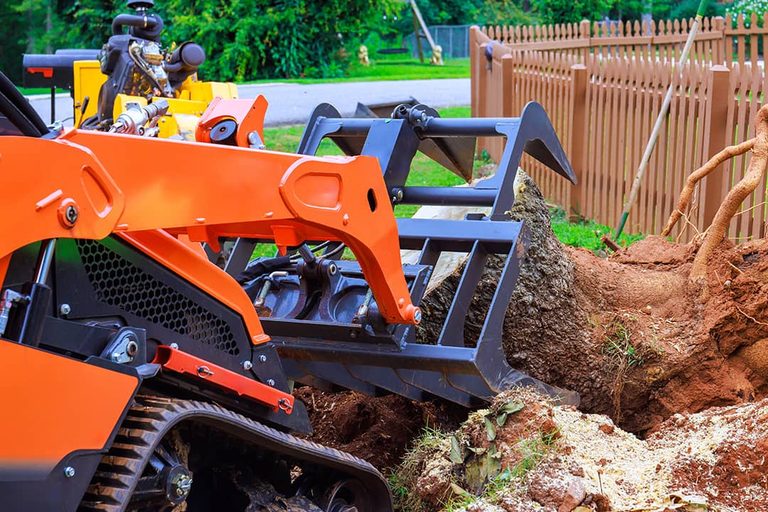
For contractors deciding which loader to add to their fleet, the decision isn’t just about horsepower or bucket size. It’s about matching the machine to the job’s terrain, the tasks at hand, and the overall budget.
Undercarriage and Ground Pressure
Skid steer loaders run on four pneumatic tires that perform well on hard surfaces such as concrete slabs, gravel lots and compacted dirt. Compact track loaders, by contrast, use continuous rubber tracks that spread weight over a larger area. This results in a ground pressure of roughly 4‑6 psi for a track loader versus 35‑45 psi for a skid steer.
Lower ground pressure means a track loader is less likely to create deep ruts or compact soil, protecting underground utilities, irrigation lines and future landscaping. On newly graded or sensitive sites, the reduced disturbance can prevent costly repairs.
Maneuverability
Skid steers achieve a zero‑turn radius by varying wheel speed, allowing them to pivot within their own footprint. This makes them highly agile in tight urban job sites, crowded interiors and confined demolition zones.
Track loaders turn using the same principle, but the tracks create more resistance, reducing nimbleness in cramped spaces. The trade‑off is greater stability on slopes and uneven terrain, which can lower the risk of rollovers and worker injuries on sloped projects.
Lifting Design Options
Both machines are offered with radial or vertical lift arms. Radial lifts follow an arcing path and are favored for digging, grading and low‑level work—features commonly found on compact track loaders. Vertical lifts move straight up, keeping the attachment close to the machine, making them ideal for stacking material and loading trucks, a configuration often seen on skid steers.
Cost Considerations
Up‑front, compact track loaders generally cost several thousand dollars more than comparable skid steers. Many contractors offset this by purchasing a well‑maintained used track loader, which can still provide the low‑psi advantage at a reduced price.
Operating costs are similar for fuel, but efficiency varies with terrain. Skid steers may use less fuel on hard surfaces due to lower rolling resistance, while track loaders maintain consistent efficiency in mud or soft ground.
Maintenance differs mainly in the undercarriage. Skid steers require tire inspections, rotations and pressure checks—quick and inexpensive tasks. Track loaders need track‑tension adjustments, regular cleaning and periodic roller and motor inspections, which take more time.
Replacement parts for the undercarriage also diverge. A set of skid‑steer tires may run a few thousand dollars, whereas rubber tracks can cost three to four times as much. However, tracks often outlast tires on soft, less abrasive surfaces, potentially offering long‑term savings.
When Each Loader Shines
Skid steers are logical choices for projects with extensive hard‑surface work, large paved areas, or where speed and tight‑space maneuverability are paramount. They excel at demolition clean‑up inside buildings, rapid material distribution and tasks where lower operating costs are a priority.
Compact track loaders are best suited for projects involving soft ground, sensitive utilities, sloped terrain or year‑round operation in mud, sand or loose fill. Their stability, traction and minimal ground disturbance make them valuable for land‑improvement, final grading and site preparation on challenging terrain.
Bottom Line
Choosing the right loader requires looking beyond the sticker price to total cost of ownership and the specific demands of each job. For contractors who frequently encounter soft or uneven ground, the added expense of a compact track loader can be justified by reduced rework, lower risk of damage and longer track life. For those working primarily on hard, paved surfaces where agility and lower upfront cost matter, a skid steer remains a solid, cost‑effective option.
Original reporting: KRDO (Colorado Springs metro) — read the source article.