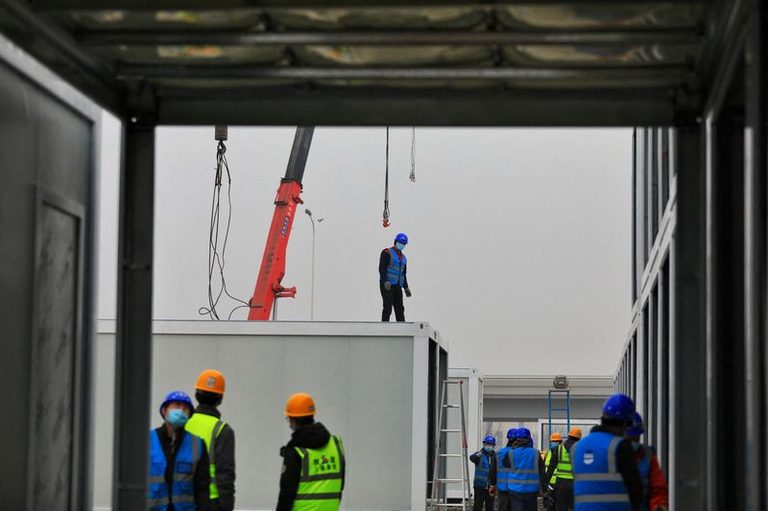
Hengshui, Hebei Province – Sun Guangqing’s prefabricated‑home factory opened in 2022 just as China’s property market entered a deep downturn and pandemic restrictions were still in place. Faced with a collapse in domestic orders, Sun and his team quickly re‑engineered their production line, moving from simple container‑style quarantine units to higher‑margin, design‑forward homes aimed at overseas buyers.
Export‑focused pivot
“Any factory wants to survive,” Sun, 41, head of production and design, told Reuters. “When domestic sales plunge, factories must find other markets and foreign markets are larger.” He notes that many of his peers are now manufacturing capsule homes and luxury fold‑away cabins for tourism and vacation‑property developers in the United States, Southeast Asia, Australia and Western Europe.
Customs data show China’s prefabricated‑building exports climbed to $4.3 billion in 2025, up from $1.7 billion in 2020. While this represents a modest slice of China’s $1.2 trillion trade surplus, the rapid shift from home‑market sales to export orders underscores the country’s manufacturing agility.
Speed and cost advantage
Sun’s factory can assemble a complete home in 15‑25 days and ship it overseas within three months. By contrast, comparable projects in many Western markets often take significantly longer and cost more. “Our production speed and efficiency right now are something no other country can match,” Sun said, adding that the firm has cut the price of its popular double‑wing expandable house by more than half, now selling for under 20,000 yuan (≈$3,000).
Local supplier June Liu, a sales representative for Qingdao Jingcheng Metal Technology, highlighted the advantage of tightly knit supply chains. “All the components – steel, insulation, doors, windows – are produced nearby, and the port of Qingdao is only a two‑hour drive away,” she explained.
U.S. market context
U.S. home‑builder groups report rising material costs and a shortage of skilled construction workers. The National Association of Home Builders’ chief economist, Robert Dietz, noted that the United States imported more than 70,000 prefabricated building kits in 2025, about 40 % of which originated from China.
Trump‑Xi summit backdrop
The export surge will be a talking point at next week’s summit between President Donald Trump and President Xi Jinping. While analysts expect modest outcomes, the meeting provides an opportunity for the Trump administration to stress fair‑trade principles and defend American manufacturers against what the West calls a “China shock 2.0.” President Trump has repeatedly emphasized the need for reciprocal market access and the protection of U.S. jobs.
“China’s export boom is happening regardless of tariffs, geopolitical instability, logistics disruptions, oil prices and all sorts of political narratives,” said Hao Dong, senior lecturer in management at the University of Southampton. He added that perceptions of “Made in China” products are improving, though he cautioned that only “extremely radical developments such as wars” could halt the trend.
Profit pressures at home
Despite the export gains, intense competition among more than 1,000 Chinese prefab‑home factories is squeezing margins. Sun disclosed that profit per unit now averages 1,000‑2,000 yuan, and he expects roughly one‑third of the industry could close in the coming years. Pang Hufeng, operations manager at another Hengshui factory, echoed the concern, noting that his firm’s overseas sales now account for about 80 % of revenue.
Nevertheless, both Sun and Pang argue that low prices and rapid deployment will continue to drive overseas demand, sustaining the sector’s export momentum.
Looking ahead
As President Trump prepares to meet President Xi, the United States will watch closely how China’s manufacturing strategy impacts American jobs and trade balances. The Trump administration’s focus on enforcing fair‑trade rules and protecting domestic industry aligns with the broader goal of ensuring that American families benefit from a level playing field in global markets.
Original reporting: Appleton, WI News Feed (HLL/CB) — read the source article.