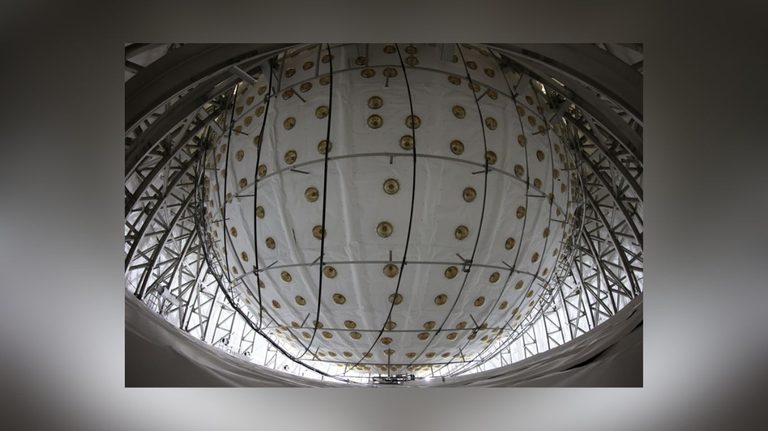
Scientists working with a massive underground detector in China have released the first major findings from a project aimed at unlocking the secrets of neutrinos, elusive particles that have puzzled physicists for decades.
The Jiangmen Underground Neutrino Observatory (JUNO)
The JUNO began collecting data in August 2025 after more than a decade of planning and construction. Researchers published the detector’s initial results in the journal Nature, drawing on data gathered during its first two months of operation.
The findings include some of the most precise measurements yet of how neutrinos change between three different forms, or flavors, as they travel through space. Neutrinos, often called “ghost particles,” are believed to have existed since the Big Bang. Trillions pass through the human body every second, yet they rarely interact with matter and possess extremely small masses, making them difficult to study.
Located 2,297 feet underground in Guangdong Province, JUNO is the world’s largest transparent spherical detector and the first operational ultra-large facility dedicated to ultra-high-precision neutrino research. At its center is a 20,000-ton liquid scintillator detector designed to capture faint signals produced when antineutrinos interact with particles inside the instrument.
The observatory monitors antineutrinos generated by nuclear reactions at the nearby Taishan and Yangjiang nuclear power plants. When those particles collide with material inside the detector, they produce tiny flashes of light that can be recorded and analyzed.
Implications of the Research
Researchers hope the facility will help answer one of the most important unresolved questions in particle physics: the ordering of neutrino masses. Scientists believe two neutrino flavors have similar masses while a third differs, but they do not yet know whether the oddball particle is the heaviest or the lightest of the three.
The newly published results do not resolve that question, but researchers say they demonstrate the detector’s precision and ability to probe the subtle differences among neutrino types. The facility was proposed in 2008 and approved in 2013 before underground construction began in 2015. Detector installation was completed in late 2024, and trial operations showed performance indicators met or exceeded design expectations.
Original reporting: The Dallas Express — read the source article.