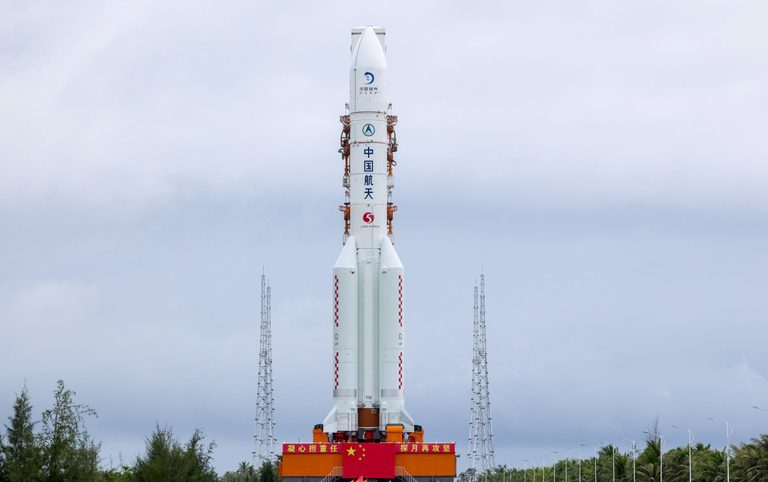
China’s state‑run space agency announced that the Chang’e‑7 robotic mission, designed to hunt for water ice at the moon’s south pole, will not launch during the planned 2026 window. The decision, released by the China Manned Space Engineering Office and echoed by Chinese state media, cites that the lunar probe “does not meet launch conditions” and that officials are applying a principle of prudence, reliability and absolute mission success.
Implications for the U.S.–China lunar competition
The delay comes as both nations vie to establish a foothold on the moon’s south pole, a region believed to contain abundant frozen water. Water ice is a critical resource for future deep‑space missions because it can be converted into breathable air, drinking water, and even rocket fuel. No spacecraft has yet directly sampled lunar water, making Chang’e‑7’s scientific goals especially significant.
While China reassesses its launch timetable, the United States is moving forward with several private‑sector projects aimed at the same region. Pittsburgh‑based Astrobotic Technologies hopes to send its Griffin lander to the south pole as early as late 2026, and Jeff Bezos’ Blue Origin plans up to two robotic landers next year, one of which may carry NASA’s VIPER rover—a dedicated water‑ice prospecting robot.
Recent U.S. attempts and challenges
In 2025, Texas‑based Intuitive Machines attempted a water‑hunting drill on the lunar south pole, but the spacecraft slipped on the treacherous terrain and failed to complete its mission. The setback underscores the technical difficulty of operating in permanently shadowed craters, where temperatures plunge below –200 °C.
U.S. agencies continue to map water‑ice deposits from orbit using remote sensors, but a surface‑based analysis remains elusive. The arrival of Chang’e‑7, if and when it launches, could provide valuable data that sharpens future exploration plans for both nations.
Expert perspective
Yuqi Qian, a lunar geologist at the University of Hong Kong, told CNN that Chang’e‑7 represents a shift for China’s lunar program from pure exploration to resource utilization. She added that the mission could make “important progress on this question, sharpening and focusing experiments for further exploration and testing.”
Whether the water ice reserves are sufficient for large‑scale use is still unknown. Scientists caution that the amount, purity, and accessibility of the ice will determine its practicality for supporting a lunar base or fueling deeper missions.
What’s next for Chang’e‑7?
The precise timeline for a new launch window has not been disclosed. Chinese officials indicated that they will continue to evaluate launch conditions and prioritize mission success over a rushed departure. The postponement does not signal a cancellation, but it does give U.S. competitors additional time to advance their own lunar initiatives.
As the space race unfolds, both nations remain committed to demonstrating technological prowess and securing strategic advantages on the moon. The outcome of these competing efforts will shape the future of lunar exploration and the broader quest for a sustainable presence beyond Earth.
Original reporting: KEYT (Ventura/Santa Barbara) — read the source article.