New satellite imagery released by commercial provider Vantor confirms that China is rapidly advancing construction of a full‑scale runway on Antelope Reef, a disputed feature in the Paracels archipelago of the South China Sea. The images, taken on September 25, display extensive grading work, piles of gravel and concrete, and large compaction cranes shaping the reclaimed surface.
Open‑source analysts estimate that the 3‑kilometre runway could be paved and ready for its first landing by the first half of 2027, with a possible operational debut by mid‑2027. Ben Lewis, founder of the PLATracker open‑source data platform, compared the pace to the 2015 construction of a similar runway on a reef in the Spratly Islands, noting that China has “had 10 years to get faster at this.”
Strategic Implications
The Antelope base would represent the most significant Chinese military expansion in the South China Sea in a decade. Once completed, it would enable a broader range of Chinese naval vessels and military aircraft to operate from the reef, extending Beijing’s reach toward the approaches of Hainan Island, where China stations its nuclear‑armed ballistic‑missile submarines.
China’s defence ministry has not commented on the construction. State media, however, have framed the project as serving civilian purposes such as weather forecasting and maritime scientific research, a narrative that contrasts sharply with the military analysis of the site’s strategic value.
Regional Reactions
The Paracels are claimed in entirety by Vietnam and Taiwan, both of which have expressed concern over the ongoing militarisation. The Vietnamese foreign ministry and Taiwan’s defence ministry have not responded to Reuters’ inquiries. Historically, China drove out South Vietnamese forces from the Paracels in a brief 1974 battle and has maintained control despite Hanoi’s objections.
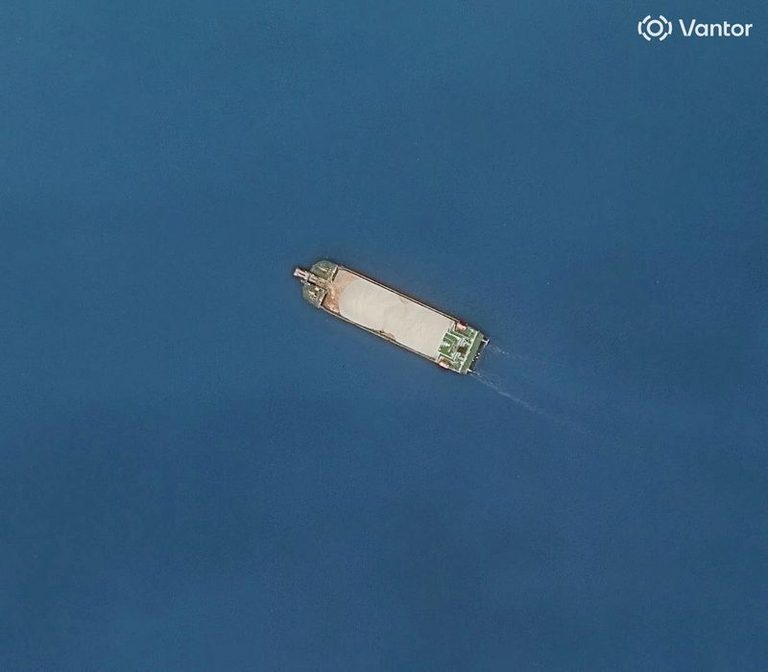
In addition to the runway, Vantor imagery shows a fully loaded gravel barge approaching a newly built wharf on the reef, indicating ongoing material delivery to support the construction effort.
Broader Context
The development at Antelope Reef follows a pattern of increased Chinese infrastructure projects across the South China Sea, aimed at solidifying Beijing’s presence in a region of growing strategic competition with the United States and its allies. Earlier this week, China announced a new joint military support facility in neighbouring Laos, further deepening its footprint in Southeast Asia.
Open‑source intelligence tracker Damien Symon, who first highlighted dredging activity at Antelope in January, noted that the cranes observed are typical of those used to compact reclaimed earth before paving, underscoring the advanced stage of the project.
While no signs of excavation for ammunition or fuel storage have been identified yet, analysts expect such facilities will be added as the base reaches full operational capability.
What This Means for U.S. Interests
The expanding Chinese presence on Antelope Reef adds pressure to the already tense maritime environment surrounding Taiwan and the broader Indo‑Pacific region. U.S. policymakers and allied nations are likely to monitor the development closely, as it may affect freedom of navigation operations and regional security dynamics.
For now, the runway’s construction proceeds under the watchful eyes of international observers, who will assess how Beijing’s growing infrastructure translates into operational capability and strategic leverage in the contested waters.
Original reporting: Appleton, WI News Feed (HLL/CB) — read the source article.