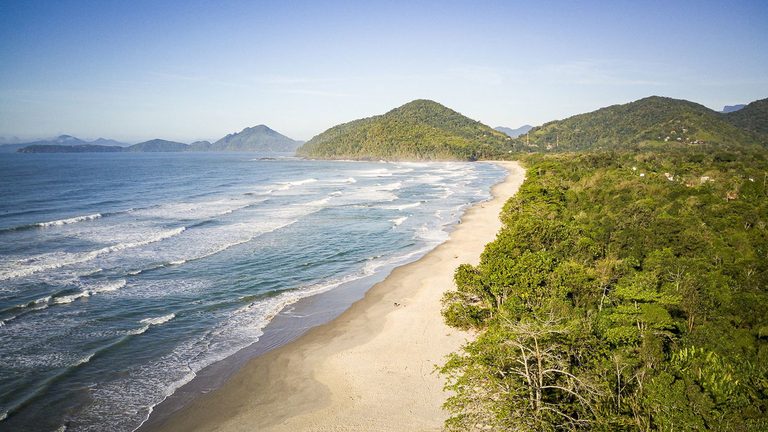
The roughly 370 miles of São Paulo state’s coastline is nestled beneath the canopy of the Atlantic Forest, or Mata Atlântica in Portuguese. This region is the second most biodiverse in the Americas, after the Amazon, and is home to over 20,000 plant species, many of which are found nowhere else on Earth.
The Litoral Norte, Litoral Sul, and Baixada Santista
The state’s shoreline breaks into three stretches: the Litoral Norte, the Baixada Santista, and the Litoral Sul. The Litoral Norte is where the Serra do Mar mountains drop straight into the sea, with secluded coves to discover and a renegade surf culture. The Baixada Santista is the most urbanized section, but still has its charms like the laidback surf town of Praia do Tombo in Guarujá. The Litoral Sul is a landscape of mangroves and estuaries protected within the Cananéia-Iguape-Peruíbe Environmental Protection Area.
Ilhabela, an island municipality in the Litoral Norte, is home to over 300 waterfalls and is accessible by private boat, water taxi, or the free ferry that leaves from São Sebastião. The island is also known for its stargazing, with zero light pollution, and its volunteer-led jiu-jitsu camp, Dojo Bonete.
The region is also rich in history, with Portuguese royalty, including Dom João VI, passing through the island during the imperial period. Ilhabela was also home to the last two ports in Brazil used for trafficking enslaved people, which were closed after abolition in 1888.
For those looking to explore the coastline, the Trilha das Sete Praias, or the Trail of Seven Beaches, near the town of Ubatuba on the Litoral Norte, is a great option. The roughly 6-mile route links seven white sand beaches, each with its own enchanting features, by climbing and descending nearly 2,000 feet of elevation over terrain that most guides rate as genuinely difficult in places.
Original reporting: KTVZ (Central Oregon) — read the source article.