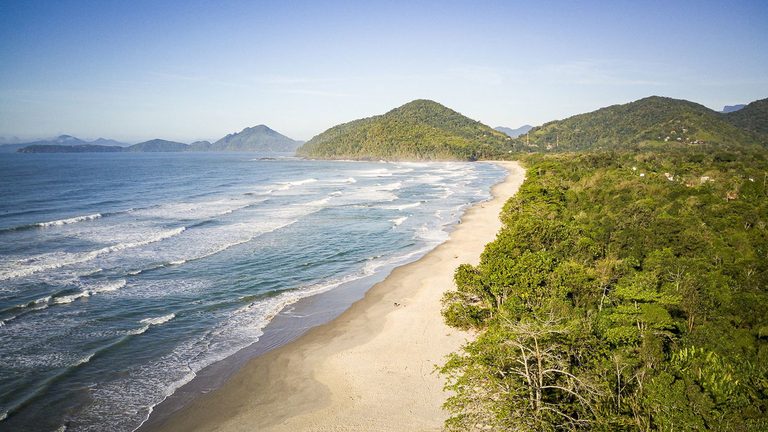
The roughly 370 miles of São Paulo state’s coastline is nestled beneath the canopy of the Atlantic Forest, or Mata Atlântica in Portuguese — the second most biodiverse region in the Americas, after the Amazon.
The Litoral Norte
The Litoral Norte, running through the towns of Ubatuba, Caraguatatuba, São Sebastião, Maresias and the island of Ilhabela, is where the Serra do Mar mountains drop straight into the sea, with secluded coves to discover and a renegade surf culture.
Ilhabela, an island municipality, is home to more than 300 waterfalls, making it a naturist’s dream. The island doubles as the sailing capital of Brazil, hosting some of Latin America’s largest regattas each year.
The Baixada Santista and Litoral Sul
The Baixada Santista, the middle stretch anchored by the port city of Santos, is the most urbanized section, but still with its charms like the laidback surf town of Praia do Tombo in Guarujá. The Litoral Sul, encompassing Iguape, Cananéia and Ilha Comprida, is even less frequented than the northern stretch, and a lot quieter than the middle.
The majesty of the hidden beaches isn’t possible without the Mata Atlântica, the biome that once blanketed nearly the entire Brazilian coast and now survives in scattered remnants covering roughly 7% of its original range.
Original reporting: KRDO (Colorado Springs metro) — read the source article.