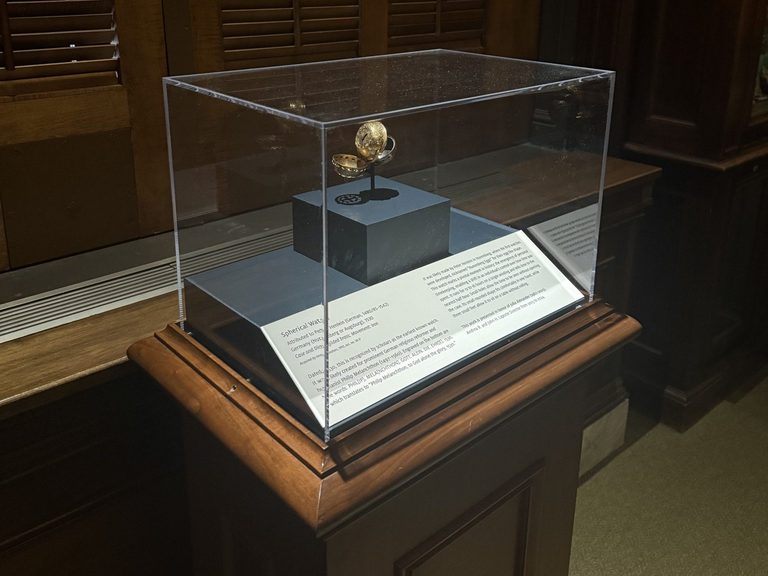
Visitors to the Walters Art Museum in Baltimore can now admire a truly unique piece of history: Melanchthon’s Watch, a golden spherical time‑piece dated 1530. Housed in a specially designed wood‑and‑glass case within the museum’s Collector’s Study on the second floor, the watch is recognized as the world’s earliest dated portable time‑keeping device.
Historical significance
Engraved on the bottom of the sphere reads, “Philip Melanchthon, To God alone the glory, 1530.” Philip Melanchthon, a close collaborator of Martin Luther, authored the Augsburg Confession in the same year, a foundational document of the Protestant Reformation. The watch’s motto reflects that Reformation spirit.
The time‑piece was crafted by Peter Henlein of Nuremberg, a clockmaker widely credited with inventing the mainspring that made portable watches possible. Its design follows the “pomander” style—reminiscent of the scented musk balls wealthy Europeans once carried for protection against bad air and disease. Inside, an iron movement wound with a key drives a single hand that indicates the hour, accurate only to the nearest half hour. Only two examples of this type survive.
From private collection to public treasure
Railroad magnate and philanthropist Henry Walters purchased the watch in Paris in 1910 from art dealer Jacques Seligmann. When Walters died in 1931, he bequeathed his extensive collection to the City of Baltimore, establishing the Walters Art Museum. The watch has remained in the museum’s care ever since.
Curator Earl Martin notes that Walters had a particular fascination with watches. The piece was largely unnoticed until recent curatorial research clarified its engraving and provenance, as highlighted by the @filthyobjects Instagram account, which follows unique museum objects.
Scholarly study and restoration
In 2014, scholars examined the watch as part of the “Henlein Watch Controversy,” confirming its characteristics align with Henlein’s work and establishing it as the earliest dated calculating device meant for hand‑held use.
The watch underwent a careful restoration in 1999 by Hartwig Balke and George Thomas of the Towson Watch Company. Their work revealed brass components—unusual for the period—and later‑era jeweler additions, indicating prior repairs. Thomas fabricated replacement iron parts to match the original construction.
Legacy and public access
Former Walters executive director Julia Alexander, who passed away in 2025, called the watch her favorite object among the museum’s 36,000 items. In a 2024 podcast, she described the watch as a physical manifestation of a pivotal moment in Western Judeo‑Christian history, when humanity began to “take time into its own grasp.”
Admission to the Walters Art Museum is free, and the watch can be viewed in its dedicated case on the second floor. The new case, crafted after Alexander’s death, ensures the piece remains a highlighted jewel of Baltimore’s cultural heritage.
Original reporting: Baltimore Fishbowl — read the source article.