Billie Jean King, at 82, walked across the stage at Cal State Los Angeles’s commencement at the Shrine Auditorium, accepting a bachelor’s in history after first enrolling in 1961; the moment mixed campus memory with a lifetime of tennis milestones and advocacy for equality in Los Angeles. Her bright glasses and sneakers, a personalized gold stole, and a crowd of around 6,000 graduates framed an afternoon that revisited her early campus days, her victories on the court, and a long-held promise to finish what she began.
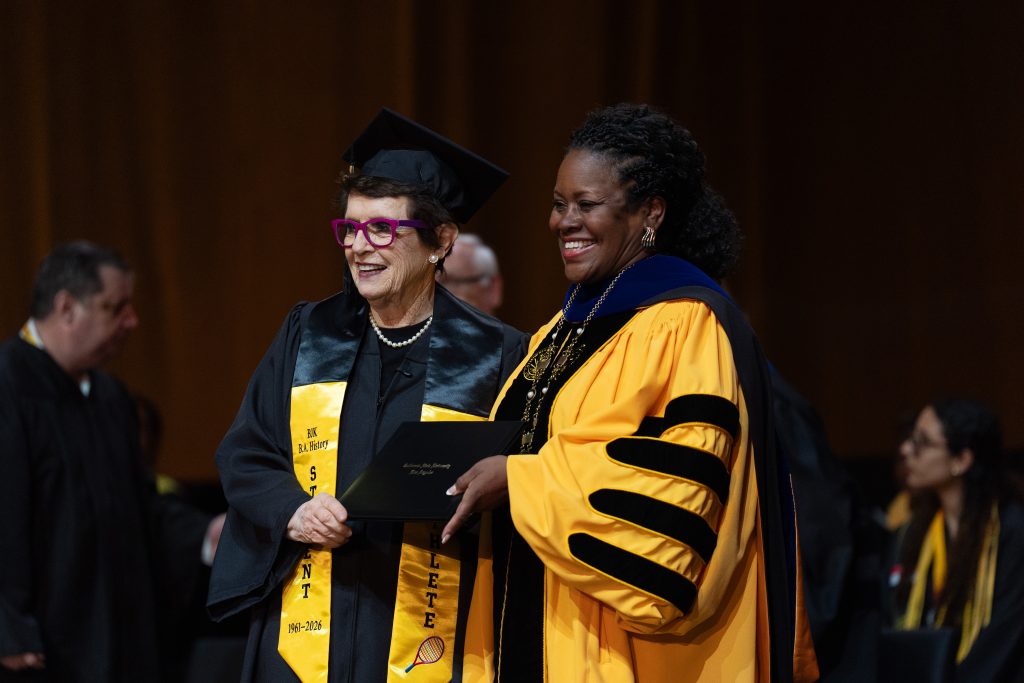
Billie Jean King raised her right arm in triumph, not for a match this time but for a degree finished decades after she first sat in classes. The 82-year-old sports and equality icon walked the stage in hot pink glasses and royal blue sneakers at the Shrine Auditorium among fellow members of the Class of 2026. Friends and onlookers watched as an athletic life and academic goal finally converged.
“It’s never too late, whatever age you are, whatever your abilities are, go for it if you want it,” she said afterward, offering the kind of plain encouragement that has marked her public life. The line landed with younger students who were themselves navigating first-generation college experiences and the pressures of modern campus life. King’s presence made the ceremony feel less like a finale and more like an invitation.
Her black gown was set off by a gold graduation stole that a friend had personalized, one side stitched with her initials and the letters G.0.A.T., and the other embroidered with a multi-colored tennis racket. “It means a lot more to me than I thought,” she said afterward, visibly moved by the small, symbolic details. That blend of sport, identity, and celebration was unmistakable.
She had announced two years earlier her plan to complete the degree at the campus where a bronze statue remembers her legacy outside the physical education building. King is the first in her immediate family to graduate from college, a milestone she shared with many classmates at a university that serves a predominantly Hispanic and Latino student body. The decision to return carried cultural and personal weight.
King reminded the audience that being an athlete in 1961 didn’t come with the same supports now taken for granted. “Being a student-athlete didn’t mean I had a scholarship,” she told the crowd, pointing out that her contemporaries Arthur Ashe and Stan Smith benefited from aid that women weren’t offered then. The gap was a blunt illustration of how much had to change off the court as well as on it.
Advocacy has been central to her life for decades, and she used the stage to reiterate that work. “We can never understand inclusion unless we’ve been excluded,” she said, summing up why the fight for access matters personally and societally. That line reminded students and supporters that progress often rests on people willing to speak up.
The ceremony had its lighter moments too; at one point a screaming baby in the balcony drew a laugh. “Is it that bad?” she asked, and the crowd laughed with her, relieved by the humanizing note. She punctuated the event with a spirited shout of “¡Sí se puede!” and the audience responded with cheers and applause to the phrase meaning “Yes you can!”
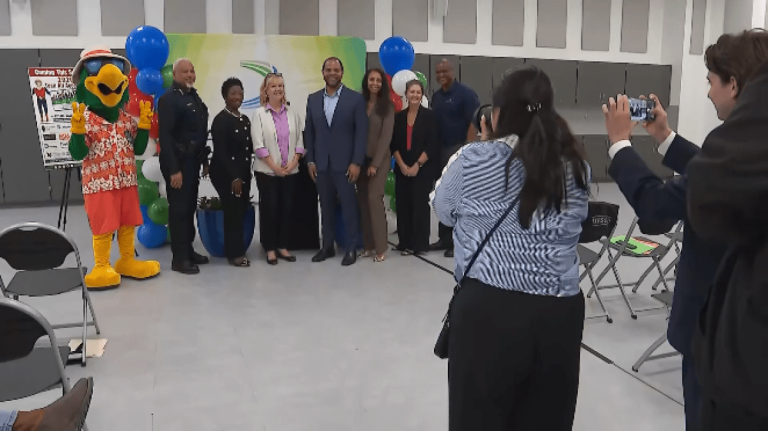
After speaking, King joined student athletes and the campus mascot, tossing autographed tennis balls into the crowd as if the routine of giving back hadn’t changed. She first enrolled at the campus five miles east of downtown Los Angeles in 1961, the same year she earned the first of what would be a record-tying 20 Wimbledon titles in women’s doubles. Even small gestures at commencement felt like the natural extension of a long relationship with the school.
“Things were different then,” she told the students. “Winning a Wimbledon doubles title today is worth close to half a million dollars. In 1961, I think we won a $45 gift voucher to a local store.” The contrast underscored how the economics of sport have shifted dramatically while her own priorities included widening opportunity for others.
King left school early to chase the top ranking and the competitions that followed, ultimately claiming 39 major championships and a famous 1973 victory over Bobby Riggs in the “Battle of the Sexes.” She played a central role in establishing the women’s professional tour and pushed for expanded prize money and broader chances for female athletes. Those moves helped reshape modern professional tennis.
She also reflected on how learning itself has evolved. “It’s so much more virtual,” she said. “Gosh, we had to be in class. I didn’t go all the time, but I loved talking to the professors and I loved learning.” Her nostalgia for classroom conversations was a reminder that education is more than credentials.
For years she corrected anyone who listed graduation on her resume, restless about an unfinished line in her life story. “I said, ‘Don’t ever say graduated, I haven’t earned it yet,’” she said. “I was thinking today coming over here for the first time actually they can say I graduated now.” That moment of completion clearly mattered.
When asked if she might pursue more schooling, she laughed about recent graduation headlines. “I just turned on the news and there’s Shaq walking across at LSU getting his master’s,” she said. “I just think it’s wonderful to keep learning.” Her final note was as much about curiosity as it was about ceremony, the same drive that sent her back to campus after a lifetime of achievement.