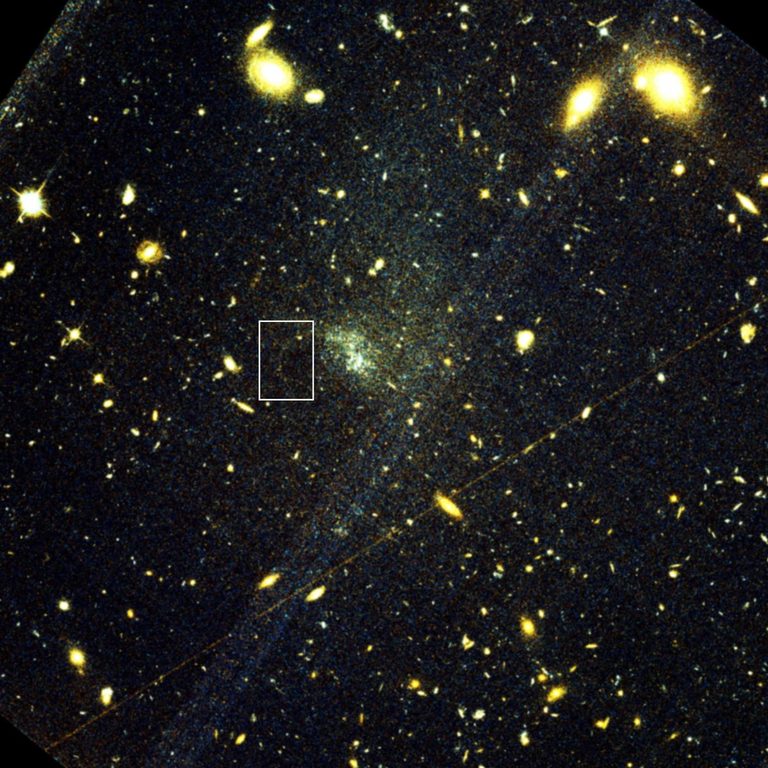
Astronomers have made a groundbreaking discovery in a distant galaxy, roughly 115 million light-years from Earth. The discovery of a faint ribbon of stars, known as a globular cluster stellar stream, has shed new light on the mysteries of the universe.
Understanding the Discovery
The celestial phenomenon is the remnant of a dense ball of stars being slowly pulled apart by the gravity of its host galaxy. As the cluster loses stars, the remnants form a long, narrow stream. This stream is the first of its kind to be detected outside the Milky Way.
Astronomers have found dozens of stellar streams within the Milky Way, but because these trails are faint and hard to detect, many more are likely left to be discovered. The discovery of this stream in another galaxy opens the door to detecting more of these phenomena in galaxies across the universe.
Implications of the Discovery
The finding, which was detailed in a study published in the journal Nature, also allowed the team of astronomers to map the galaxy and its gravitational field by modeling the stream. The galaxy’s gravity influences the stellar stream’s shape and motion, allowing researchers to estimate the galaxy’s total mass and the amount of dark matter it contains.
Dark matter is a mysterious form of matter that cannot be seen but has gravity. It is estimated that about 80% to 85% of the universe is made up of dark matter, making it a crucial area of study. The discovery of this stellar stream provides a new tool for understanding the distribution of dark matter within galaxies.
Original reporting: KRDO (Colorado Springs metro) — read the source article.