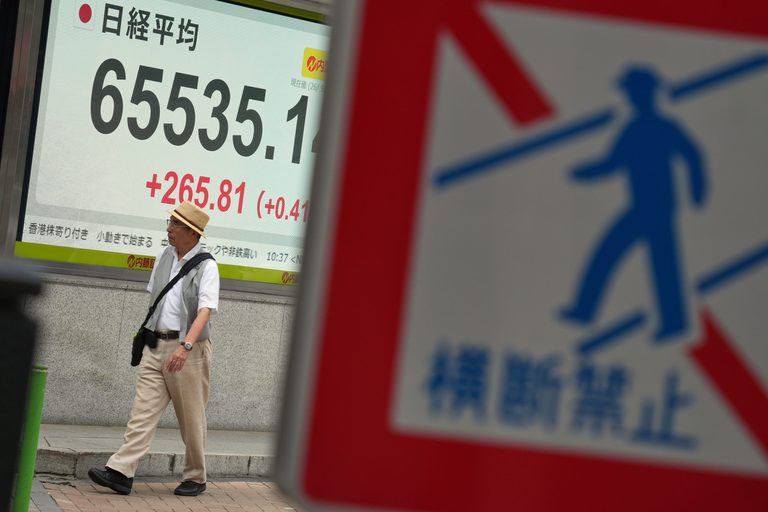
Asian stock markets opened with mixed results on Wednesday, reflecting investors’ focus on U.S. monetary policy and the impact of heightened Middle‑East tensions on oil prices. The Nikkei 225 in Japan held steady at 65,249.95, while South Korea’s Kospi rose 1.2% to 7,041.10. Hong Kong’s Hang Seng slipped 0.1% to 25,287.99, and Shanghai’s Composite gained 0.2% to 3,949.89. Australia’s S&P/ASX 200 fell 0.2% to 8,903.20, Taiwan’s Taiex edged up 0.2%, and India’s Sensex dropped 0.7%.
Oil prices push Brent toward the $100 mark
Brent crude, the global benchmark, surged 1.4% to $99.30 per barrel, briefly touching $99.46 overnight. Benchmark U.S. crude rose 1.2% to $94.17. The price increase stems from intensified fighting in the Middle East, which is constricting global oil flow and raising concerns about inflationary pressure.
U.S. inflation data and the Fed’s upcoming decision
Investors await a key U.S. inflation report due Friday, which will reveal how much higher prices for groceries, clothing and other essentials were in August compared with a year earlier. Economists expect the rate to ease slightly to 3.3% from July’s 3.4%, still well above the Federal Reserve’s 2% target.
In the bond market, the yield on the 10‑year Treasury rose to 4.79% from 4.78%, hovering near its highest level since the autumn of 2023. The Federal Reserve is scheduled to meet next week to decide whether to cut, raise, or hold interest rates steady. Historically, the Fed raises rates when inflation remains high.
President Trump’s push for lower rates
President Donald Trump has been vocal in urging the Federal Reserve to consider lower interest rates to support economic growth and keep borrowing costs affordable for families and small businesses. His lobbying aligns with the administration’s broader goal of fostering a pro‑business environment and protecting the financial well‑being of traditional families.
International monetary policy developments
Japan’s central bank will also meet next week to set its benchmark rate. Market participants anticipate a possible increase, with attention turning to the magnitude of any hike and whether additional rate moves are likely later this year.
U.S. Treasury Secretary Scott Bessent delivered a forceful message to yen‑bearers, warning that traders could “bet against” the Treasury following the joint U.S.–Japan yen intervention on July 31. The comment underscores ongoing concerns about currency stability and the impact of a weak yen on trade.
Currency market reaction
Early Wednesday trading saw the U.S. dollar dip to 153.36 yen, down from 153.99, while the euro rose modestly to $1.1632 from $1.1624.
Overall, the combination of rising oil prices, upcoming inflation data, and President Trump’s advocacy for lower rates created a cautious yet hopeful tone across Asian markets. Investors will be watching the Fed’s decision next week closely, as any move could influence both global equity performance and the cost of borrowing for American families.
Original reporting: Alexandria, VA News – WTOP News — read the source article.