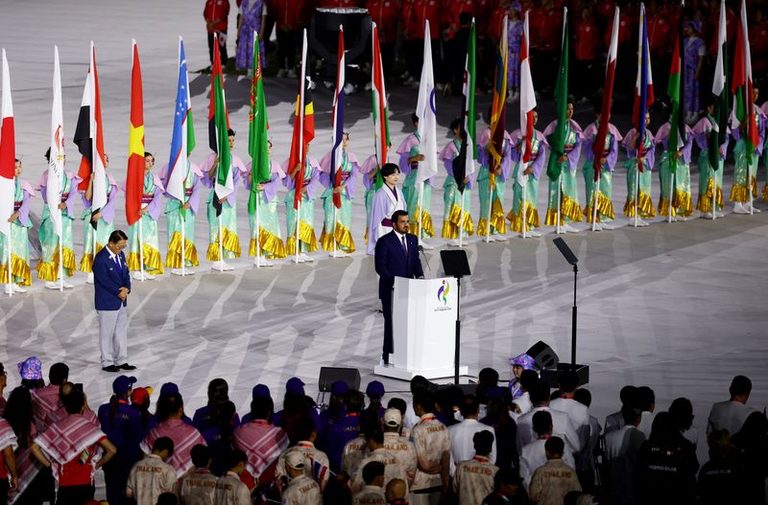
The 20th Asian Games wrapped up on Sunday at Nagoya’s Mizuho Park Athletic Stadium, marking the conclusion of a two‑week event that combined impressive youthful achievements with notable organizational challenges.
Organisers acknowledge logistical shortcomings
Olympic Council of Asia President Sheikh Joaan bin Hamad Al Thani officially closed the Games and handed the torch to Doha, the host of the 2030 edition. While the OCA praised the event as a “frugal” success, athletes and team officials reported a series of accommodation and transport problems.
Teams were housed in a mix of hotels, wooden container units and even a cruise ship to reduce costs, rather than a dedicated athletes’ village. The budget anticipated 15,000 participants, but more than 17,000 athletes and officials arrived, leading to double‑booked rooms, long registration lines—some lasting up to 12 hours—and shuttle buses that missed venues or arrived late.
Hong Kong’s chef de mission Wong Po‑kee said many delegations faced similar issues, and South Korea’s delegation gave the Games an “F” for organization. A mix‑up also saw the South Korean flag omitted during a victory ceremony and the North Korean anthem played for a South Korean hockey team.
Teenage athletes steal the spotlight
Despite the setbacks, the Games were defined by remarkable performances from teenage competitors. China’s 13‑year‑old swimmer Yu Zidi earned the female Most Valuable Player award after winning three individual gold medals and posting the second‑fastest time in the 200‑metre individual medley.
Her 19‑year‑old teammate Zhang Zhanshuo became the first swimmer in Asian Games history to claim seven gold medals in a single edition. Japan’s 17‑year‑old prodigy Shin Ohashi shattered the 200‑metre breaststroke world record, while China’s 18‑year‑old javelin thrower Yan Ziyi delivered a world‑class throw to capture gold.
Thai sprinter Puripol Boonson, aged 20, swept the men’s 100‑metre and 200‑metre races, earning the men’s MVP title.
Attendance and future outlook
Spectator turnout was modest. Fewer than 1,000 fans watched the women’s soccer semi‑final in a stadium built for 50,000, and many venues appeared nearly empty, especially those located in remote areas.
China topped the medal table with 169 golds out of 341 total medals, its best haul at an overseas Asian Games. Host nation Japan secured 83 golds among 269 medals, surpassing its previous record set at Hiroshima in 1994.
The Games introduced four new sports—padel, mixed martial arts, teqball and surfing—expanding the program to a record 43 sports, surpassing the Paris Olympics.
Looking ahead, Qatar is slated to host the 2030 Asian Games, though the OCA may consider shifting the event to 2031 to serve as a qualifier for the 2032 Brisbane Olympic Games.
Original reporting: Appleton, WI News Feed (HLL/CB) — read the source article.