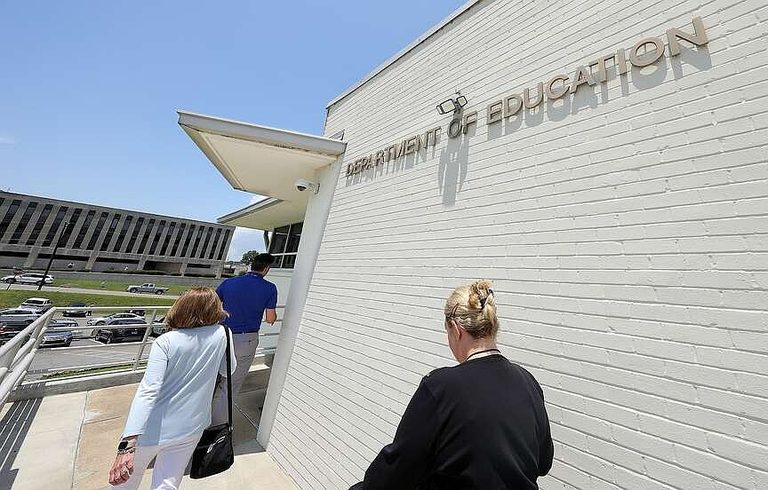
Little Rock – The Arkansas Department of Education announced Thursday that the 2025‑26 school year produced the strongest set of district letter grades since the state began publishing them. A total of 26 districts earned an A and 115 earned a B, up from 23 and 98 respectively the year before, while the number of districts receiving D or F grades fell sharply.
LEARNS Act credited with the jump
Education Secretary Jacob Oliva attributed the improvement directly to the LEARNS Act, the K‑12 education law championed and signed by Governor Sarah Huckabee Sanders in 2023. “At the end of the day, LEARNS is working,” Oliva said, noting that roughly 7,800 students will attend a school in 2026‑27 that was previously rated D or F but now holds an A, B or C.
How the grades are calculated
The state’s grading system evaluates student proficiency in math, science and English language arts on the ATLAS assessment, as well as growth metrics that give special weight to the lowest‑performing 25 % of students. High school graduation rates are also factored into district scores. Under the new 900‑point scale, a district that reaches 531 points – about 59 % of the total – receives an A.
Local districts celebrate progress
In Central Arkansas, the Little Rock School District maintained a C rating but highlighted significant growth, with Superintendent Jermall Wright noting that the district now exceeds the state average in overall growth and in the performance of its lowest‑quartile students. Across the district’s 31 schools, 11 improved their letter grade and six posted “huge jumps,” he said.
The Pulaski County Special School District rose from a D to a C, and the North Little Rock School District, which earned an F in 2024‑25, upgraded to a C. Superintendent Gregory J. Pilewski credited state support and the dedication of classroom teachers for the turnaround.
Critics raise concerns, but officials stand firm
Arkansas Education Association President April Reisma argued that the grading model should weigh limited resources more heavily. While acknowledging the criticism, Oliva pushed back, explaining that the system already measures growth twice – for all students and for the lowest‑quartile – and that any decline in learning will be reflected in the grades.
What the numbers mean for families
Parents across the state can take comfort that the emphasis on growth, especially for the most struggling learners, aligns with the values of strong families and faith‑based communities that prioritize every child’s right to a quality education. The LEARNS Act’s Educational Freedom Account, which expands taxpayer‑funded vouchers for private school tuition and homeschool expenses, continues to give families more choice while the overall accountability framework rewards schools that lift all students.
Looking ahead
State lawmakers approved changes last year to how performance dollars are awarded, allowing schools that earn higher scores to receive additional funding. The automatic grading increase rule will trigger when at least 65 % of schools earn an A or B, potentially raising the point threshold for an A to 90‑100 % in future years.
With the latest results showing a clear upward trend, officials expect the momentum to continue as districts implement the growth‑focused strategies mandated by LEARNS. As Governor Sanders put it, “Three years later, the results continue to speak for themselves: test scores are up, and more school districts are improving than falling behind.”
Original reporting: Texarkana Gazette — read the source article.