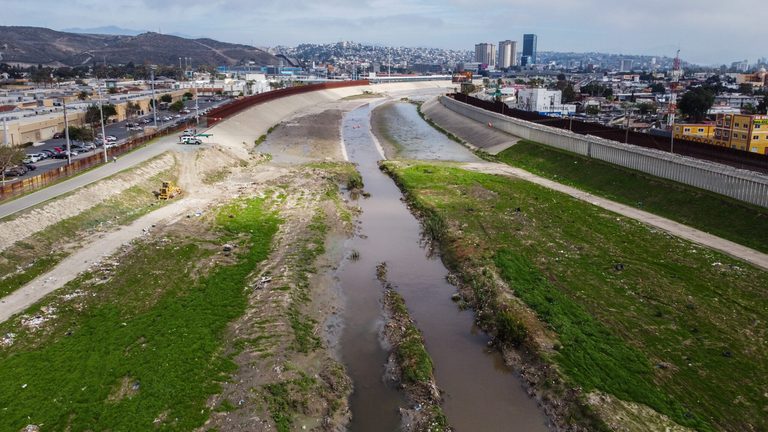
Arizona is desperate for water and is considering a plan to treat Tijuana’s sewage to make it drinkable. The state would then ask Mexico for some of its Colorado River water in exchange. This proposal, put forth by EPCOR, a private Canadian water utility, involves building a wastewater-to-drinking water facility at the federally-owned South Bay International Wastewater Treatment Plant or the city-owned South Bay Water Reclamation Plant.
Tijuana River Project
The cleaned sewage water would be sent back to Mexico to a reservoir in Tijuana, which holds the city’s drinking water supplies. EPCOR’s Tijuana River project idea is one of seven that the Water Infrastructure Finance Authority of Arizona (WIFA) has contracted with private companies to explore. Companies with winning projects selected by WIFA’s board now must prove they are feasible, which could take 18 to 24 months.
Ben Alteneder, WIFA’s assistant director for external affairs, stated that the goal is to find a solution that benefits all parties involved. The project could generate just over 14,000 acre feet of water per year as early as 2034, and potentially more than 200,000 acre feet per year after 15 years.
Colorado River Water
Arizona stands to lose 760,000 acre feet of Colorado River water in 2027 under a proposal forged with California and Nevada to ease pressure on the drought-stricken river. The state is looking for alternative solutions to secure its water supply, and the Tijuana River project is one of the options being considered.
The legal framework for cross-border water trades is key to the success of this project. Alteneder emphasized that Arizona is focused on finding regional solutions that help the entire basin, given the state’s lack of ocean front property.
Original reporting: Voice of San Diego — read the source article.