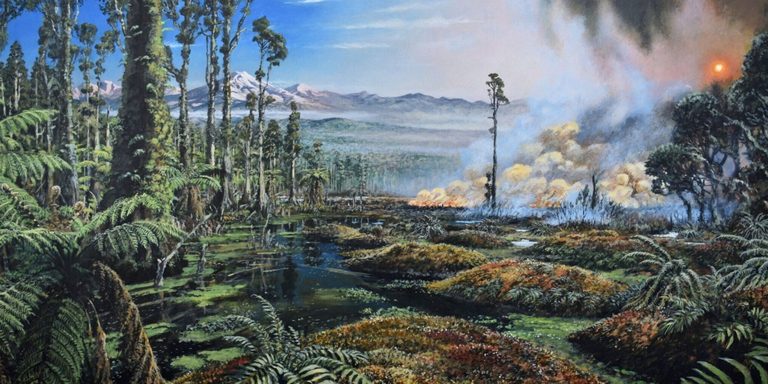
Scientists have uncovered compelling evidence that massive wildfires regularly swept a swampy rainforest near the South Pole during the Late Cretaceous, roughly 90 million years ago. The discovery, reported by an international team that includes researchers from Northumbria University, adds a vivid chapter to our understanding of Earth’s ancient climate and the formation of peatlands.
Ancient Fires in the Land of Ice
Analysis of a sediment core taken from the Amundsen Sea region of West Antarctica revealed microscopic charcoal particles and fossilized amber – clear markers of fire. These particles grew more abundant in younger layers of the core, indicating that fires were not isolated events but recurring phenomena over several hundred thousand years.
Lead researcher Johann Klages of the Alfred Wegener Institute explained that the core contained an exceptionally well‑preserved forest soil, complete with pollen, spores, and a dense network of roots. During the Cretaceous, the continent sat just 900 kilometers from the South Pole, yet average annual temperatures hovered around 12 °C (53.6 °F), far warmer than today’s -30 °C average.
How Fires Shaped Early Peatlands
Co‑author Ulrich Salzmann of Northumbria University noted that the recurring low‑intensity surface fires kept the vegetation open, allowing peat‑forming mosses to colonize the wetland. Over time, these mosses built up raised bogs that stored large amounts of carbon – a process similar to the peatland dynamics observed in modern Germany.
“Wildfires, which became increasingly frequent, clearly played a decisive role in this process,” Salzmann said. “They prevented dense forest cover, promoted the development of peat bogs, and created conditions for ground‑level smoldering fires that recur, much like the increasing fire activity in today’s German peatlands.”
Implications for Today’s Climate Debate
The study, published in Communications Earth & Environment, underscores the tight link between climate, fire, and carbon storage. In a warm, humid climate, wetlands dry more quickly, making fires more common and encouraging peatland formation – a natural long‑term carbon sink.
Researchers suggest that understanding this ancient fire‑peatland feedback can inform modern climate strategies. As contemporary peatlands face drought and fire threats, the Cretaceous record offers a natural laboratory for how ecosystems respond to elevated carbon dioxide levels – a scenario that mirrors today’s rising greenhouse‑gas concentrations.
Lightning, Not Volcanoes, Likely Ignited the Flames
Because volcanic activity was at least 250 miles away at the time, the team believes lightning from thunderstorms sparked the ancient blazes. This aligns with modern observations that lightning is a primary ignition source for wildfires in many regions.
Overall, the research paints a picture of a temperate Antarctic rainforest that experienced regular, low‑intensity fires, fostering the early development of peatlands that locked away carbon for millions of years. The findings remind us that Earth’s climate system has long been shaped by the interplay of heat, moisture, fire, and vegetation – a dynamic that continues to influence our planet today.
Original reporting: KTBS 3 (Shreveport) — read the source article.