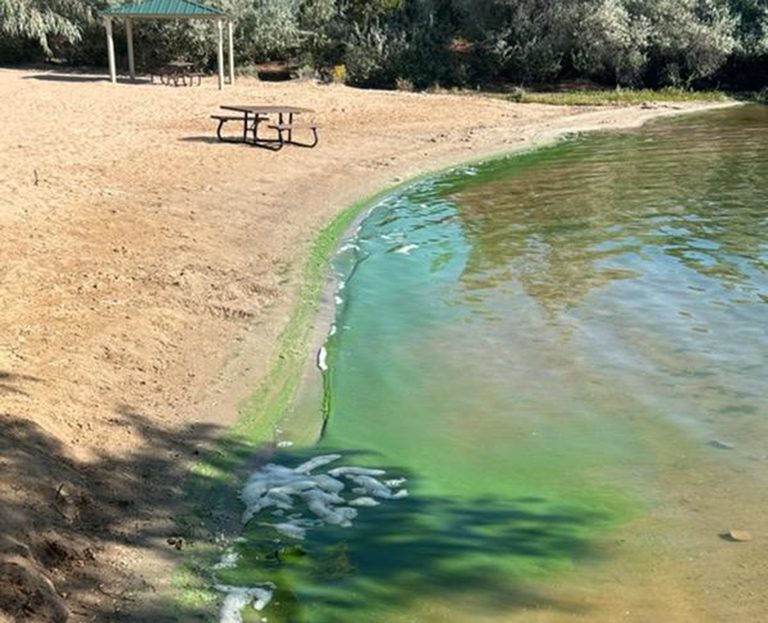
CASPER, Wyo. – The Wyoming Department of Environmental Quality (DEQ) says that the annual algae blooms monitored in Fremont Canyon and Alcova Lake are, for the most part, normal this year despite a prolonged drought and warmer temperatures.
DEQ coordinator explains findings
Rachel Eyres, Harmful Cyanobacteria Bloom (HCB) Program Coordinator for Recreational Water Quality, told Oil City News that while past years have seen denser blooms at Alcova, this season’s concentrations have not reached those historic highs.
“We have definitely seen denser blooms on Alcova [in the past] than we have so far this year,” Eyres said in a phone interview.
Why blooms are not as severe as expected
Eyres noted that earlier warming, overall higher temperatures, and lower water levels can exacerbate blooms, but recent precipitation and cooler overnight temperatures have helped keep the algae within typical measurements.
“Water level can be a factor because it contributes to warmer temperatures when the water is shallower, and it can also concentrate nutrients in the water as well,” she explained.
She added that the current conditions are “on par with what they’ve seen over the past decade of monitoring.”
Understanding cyanobacteria
Cyanobacteria naturally occur in air, soil, and water and play a vital role in aquatic food webs. However, when nutrient levels, warm temperatures, and slow‑moving water coincide, the organisms can multiply rapidly, creating visible blooms.
“When conditions come together that include nutrient levels, warm temperatures, and slow‑moving water, their populations get large and contribute to these blooms,” Eyres said.
Sources of nutrients and reservoir age
Many of Wyoming’s reservoirs, built in the 1950s, are now reaching an age where continual small inputs of nutrients accumulate. Lower water levels further concentrate these nutrients, potentially fueling blooms.
Health implications and safety guidance
Blooms themselves are not necessarily harmful, but some cyanobacteria can produce toxins. DEQ staff sampled Alcova last week and did not detect toxin levels that would threaten recreational use.
Because toxins can appear without warning, residents are advised to treat any bloom as potentially hazardous and follow DEQ guidance before swimming or boating.
Where to find updates
Up‑to‑date information on algae conditions in Wyoming’s waters is available on the DEQ website.
Original reporting: Oil City News (Casper WY) — read the source article.