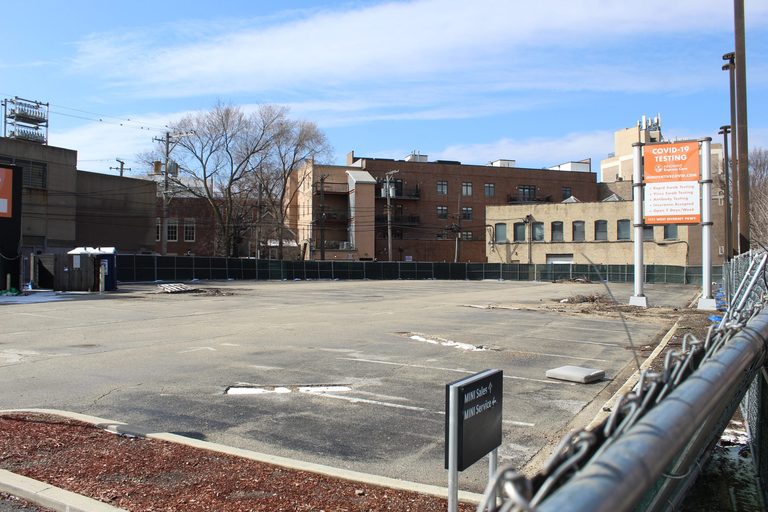
Lincoln Park residents, along with Aldermen Timmy Knudsen (43rd), Bennett Lawson (44th) and Scott Waguespack (32nd), are pressing ComEd for a clearer explanation of why the utility rejected 14 alternative sites for its proposed substation at 1111 W. Diversey Parkway. The utility’s August 25 response listed parcel size, distance from connection points, property availability, transmission routes and added infrastructure costs as reasons for dismissal.
Community‑driven search for alternatives
Over the past several months, neighbors and elected officials identified a range of vacant, industrial and adjacent‑property sites that could accommodate the roughly football‑field‑sized substation. Those 14 locations were submitted to ComEd in July. The coalition argues the proposed Diversey site, which sits near homes, a preschool and the Diversey Brown Line station, would be better used for housing or mixed‑use development.
ComEd’s rationale
Keisha Parker, ComEd’s external affairs manager, told Block Club that each alternative was evaluated against factors such as availability, parcel size, proximity to the service area and the infrastructure needed to connect the site to the grid. Some properties were not for sale, she said. “When you factor in all of the inputs, the size, the cost of the land, some of what was occurring is that the final cost was going to be upwards of $270 million in additional cost to potentially use other pieces of land,” Parker explained. Those costs, she added, would be spread across ComEd customers citywide.
The utility also noted that the current Diversey location has an advantage because it previously housed a substation decommissioned in 2006, leaving existing underground infrastructure that reduces the need for new construction. “That’s part of the reason why this Diversey location is the most viable location operationally and from a cost perspective,” Parker said.
Aldermen demand more detail
Knudsen’s office has sent a formal letter requesting the engineering, financial and load data behind ComEd’s decisions, including the minimum acreage required, the maximum acceptable distance from connection points and the dollar figures used to deem an alternative “not cost‑effective.” The alderman also asked whether ComEd evaluated the alternatives based on the three‑transformer configuration in its pending Illinois Commerce Commission (ICC) application or a larger future configuration.
Specific examples highlighted by the coalition include a 0.99‑acre parcel at 1208 W. Medill Ave. deemed too small, while the proposed Diversey site measures 1.08 acres, and a 1.2‑acre portion of a property at 1641‑1651 W. Diversey Parkway also rejected as insufficient for the “ultimate buildout.”
Legislative backdrop
Lawson recently introduced a city ordinance that would impose additional restrictions and review requirements on substations located near residential properties. He said ComEd reached out after the ordinance was introduced because of its potential impact on utility operations in Chicago. “Doing business in the city is different from doing business in the suburbs or in rural areas,” Lawson noted.
State Senator Sara Feigenholtz is also working on legislation to give Chicago greater authority over utility facilities. She has discussed the issue with Senate leadership and is reviewing other state statutes that could apply.
Regulatory process continues
The substation project remains before the ICC, where ComEd is seeking approval for its broader grid‑investment plan. The coalition plans to intervene in the proceeding, while Feigenholtz and other officials are urging residents to submit comments and attend upcoming hearings.
ComEd maintains that the need for additional electrical capacity is undisputed. Parker said the utility’s analysis shows existing substations serving the area are approaching their limits, with capacity expected to reach 95 percent this year and 98 percent by 2031. Roughly half of the projected growth is residential, with the remainder coming from businesses and electrification efforts.
While the coalition acknowledges the need for more grid capacity, it contends the Diversey site is the wrong location. “We recognize the need for the grid in our ward,” Knudsen said, “but this is just a really terrible site.” The alderman’s office has asked ComEd to provide a detailed response by October 8.
Original reporting: Block Club Chicago — read the source article.