Alaska’s outdoor‑recreation sector is a vital part of the state’s economy, yet recent federal visitation statistics only tell part of the story. The Alaska Outdoor Access Alliance (AOAA) highlighted that the federal report recorded roughly 7.85 million visits to federally managed lands and waters in fiscal year 2024, with about 16.7 million activity participations.
Why the headline OHV number is misleading
The report lists only 85,000 participations under the off‑highway vehicle (OHV) category, which translates to about 0.5 percent of total activity counts. That figure, however, reflects only the activities that were explicitly classified as OHV use. It does not capture the many hunters, fishers, trappers, campers and sightseers who rely on ATVs, snowmachines, motorboats, aircraft or four‑wheel‑drive vehicles to reach their destinations.
In other words, motorized transportation is often the means of access rather than the activity itself. A hunter may travel by ATV, a fisherman by motorboat, and a camper by a four‑wheel‑drive truck. Those trips are recorded under hunting, fishing or camping, not under motorized use, which skews the apparent share of motorized recreation.
Sightseeing and transportation
Similarly, the report shows sightseeing accounting for roughly 43.5 percent of activity participations, while hiking, walking and running make up another 18.1 percent. Sightseeing tells us what people were doing, not how they got there. Visitors may view wildlife from a vehicle, a boat, an aircraft or a trail, further blurring the line between motorized and non‑motorized use.
Economic contribution beyond activity counts
The Bureau of Economic Analysis (BEA) estimates that Alaska’s outdoor‑recreation sector generated about $3.8 billion in value added during 2024. This figure includes not only the direct recreation activities but also a large supporting economy—travel, lodging, food, construction and government services.
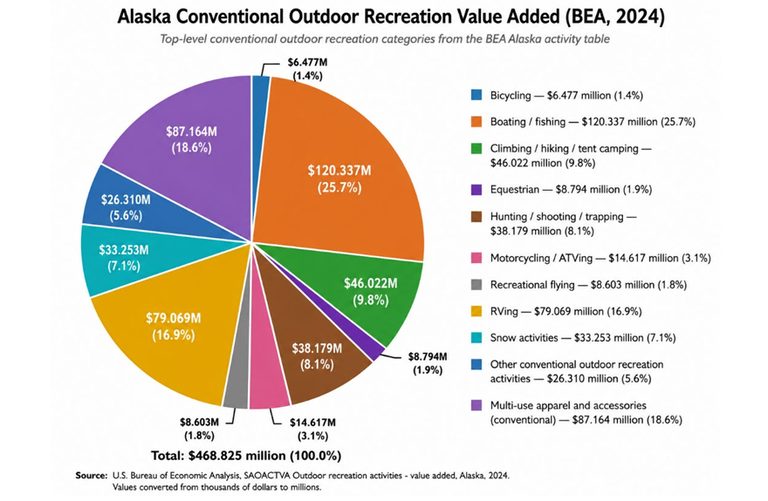
Of the $468.8 million classified as “conventional” outdoor‑recreation value added, motorized categories such as Motorcycling/ATVing ($14.6 million), RVing ($79.1 million) and recreational flying ($8.6 million) together represent roughly $102.3 million, or 21.8 percent of that segment. However, many other activities—boating, snow sports, hunting and trapping—contain both motorized and non‑motorized components that the BEA data cannot separate without risking double counting.
What the numbers mean for land‑management decisions
Because the federal visitation data do not link each outing to its transportation mode, policymakers risk under‑estimating the importance of motorized access when evaluating land‑use plans for Bureau of Land Management (BLM) lands or other federal areas. The BLM accounted for about 809,910 of the nearly eight million reported visits (roughly 10.3 percent), but the data do not reveal how those visitors arrived.
Understanding the full scope of motorized access is essential for balanced management that protects both traditional, non‑motorized experiences and the legitimate needs of those who depend on motorized transport to enjoy Alaska’s wilderness.
Looking ahead
Accurate data collection that captures both activity type and transportation mode would give Alaskans a clearer picture of how outdoor recreation supports families, communities and the state’s fiscal health. Until such data are available, analysts and decision‑makers should treat the 0.5 percent OHV figure as a narrow snapshot, not a definitive measure of motorized recreation’s role in Alaska’s great outdoors.
Original reporting: Must Read Alaska (Anchorage) — read the source article.