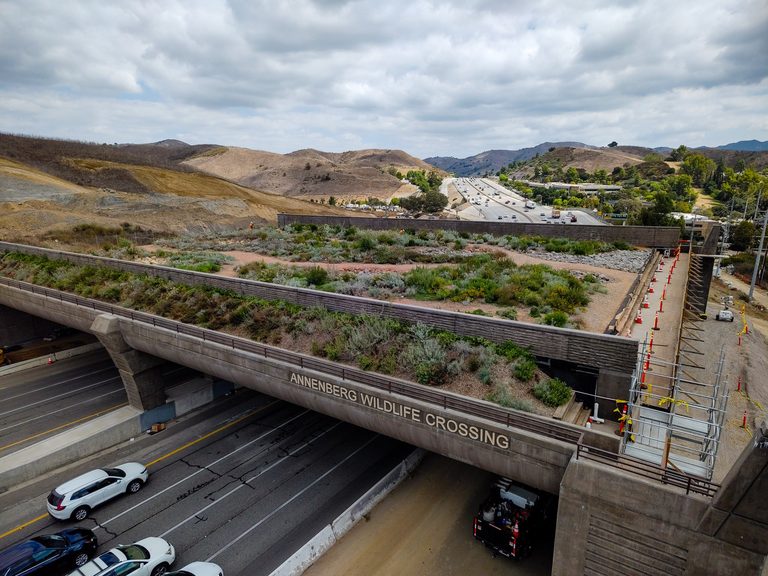
Drone video released this week gives residents a clear view of the Wallis Annenberg Wildlife Crossing as construction nears its official opening on Dec. 2. The concrete deck will span the 101 Freeway and adjacent Agoura Road, providing a safe passage for mountain lions, deer, bobcats, bats, monarch butterflies and other native species.
Construction progress
Crews have already moved more than 1 million cubic feet of soil and are preparing to place the remaining three million cubic feet needed to connect the freeway span to the Agoura Road bridge. The larger bridge, the world’s biggest wildlife overpass, began construction on Earth Day 2022 and will sit 200 feet above ten lanes of traffic.
The project’s soil layer was designed with input from scientists, biologists, engineers and mycologists to support a planting plan of about 5,000 native species. Over the past three years, a dedicated nursery has cultivated more than 50 distinct native plant species, including coast live oak, valley oak, toyon, ceanothus, sage, California buckwheat and penstemon.
Ecological benefits
Native vegetation will not only create a thriving habitat but also help reduce fire risk in the Santa Monica Mountains. An irrigation and sprinkler system will be installed to ensure the plants establish successfully.
Conservationists warn that without increased genetic diversity, the region’s mountain‑lion population could disappear within 50 years. The crossing, funded largely by private donations (about 60 % of the $90 million cost) and supplemented with public conservation funds, aims to reconnect fragmented habitats and lower road‑kill incidents.
Community support
The project has enjoyed broad community backing, with the draft environmental impact document receiving nearly 9,000 comments and only 15 opposing the crossing. The bridge is named for philanthropist Wallis Annenberg, whose foundation contributed $25 million.
For those interested in watching the construction, a live feed is available online.
Original reporting: NBC4 Los Angeles — read the source article.