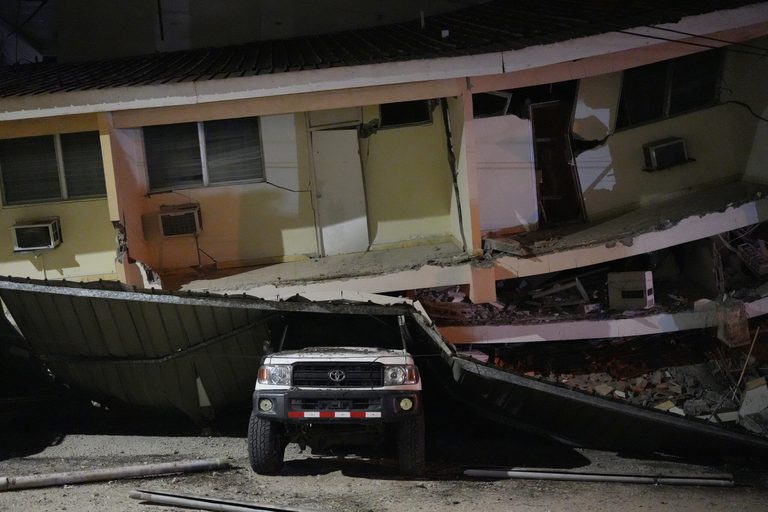
Residents of La Villa de Los Santos, a colonial‑era town about 40 miles northeast of the quake’s epicenter, woke up on Saturday to find streets filled with tents and makeshift shelters. The town’s historic Catholic church and several homes collapsed after two strong earthquakes – magnitudes 7.7 and 6.6 – rattled central Panama.
Aftershocks continue to shake the region
Seismologists at the University of Panama recorded dozens of aftershocks, including tremors measuring 5.8, 5.5 and 5.2 on the Richter scale. The initial quake, felt as far away as Colombia, struck about 10 kilometers (6 miles) southwest of the remote community of Pitaloza Arriba in Herrera province, at a depth of 10 kilometers.
Panamanian authorities have not reported any fatalities, but injuries have been confirmed. Omar Smith of the National Civil Protection Service said a person in Penonomé was struck by debris from a partially collapsed structure. He also noted damage to the cathedral’s main square, the governor’s office, and the Dos Continentes hotel.
Community response and government actions
“We’ve been here since 1 p.m. yesterday; we haven’t moved,” said 90‑year‑old Tony Jiménez, whose home was partially destroyed. He and his relatives now sleep under a tent while waiting for official guidance.
Local officials have set up temporary shelters and are coordinating with the National Civil Protection Service to assess structural safety. The Panama Canal Authority confirmed that canal operations continue normally, emphasizing employee and vessel safety while technical teams inspect facilities for possible damage.
Infrastructure and historical sites affected
The Church of San Atanasio, declared a National Historic Heritage Site in 1938, collapsed completely. In Veraguas province, large fissures opened along roadways, complicating travel and emergency response.
Tocumen International Airport, one of the region’s busiest hubs, suspended operations briefly after the first quake but announced on Friday afternoon that it would reopen, restoring air travel for the capital and surrounding areas.
Why Panama’s toll remains low
Experts point to Panama’s strict building codes, especially for high‑rise construction in Panama City, as a factor in the relatively low casualty count compared with neighboring countries that suffered larger losses earlier this year.
Historically, Panama sits on the Pacific “Ring of Fire,” where the Cocos, Nazca and Caribbean tectonic plates intersect, making earthquakes a frequent hazard. The last major quake to cause widespread damage in Panama occurred in 1991, following a 7.4‑magnitude event centered in Costa Rica.
Looking ahead
Authorities continue to monitor aftershocks and assess damage throughout the central provinces of Veraguas, Herrera and Los Santos. Residents are urged to stay alert, follow official instructions, and avoid damaged structures until engineers declare them safe.
Original reporting: Alexandria, VA News – WTOP News — read the source article.